
3D Engineering Animation Best Practices: Accuracy, Clarity, and Revision Control (What Marketing Teams Must Ask For)
May 19, 2026
WebXR for Manufacturing Marketing: Interactive Product Demos That Work on Any Browser
May 21, 2026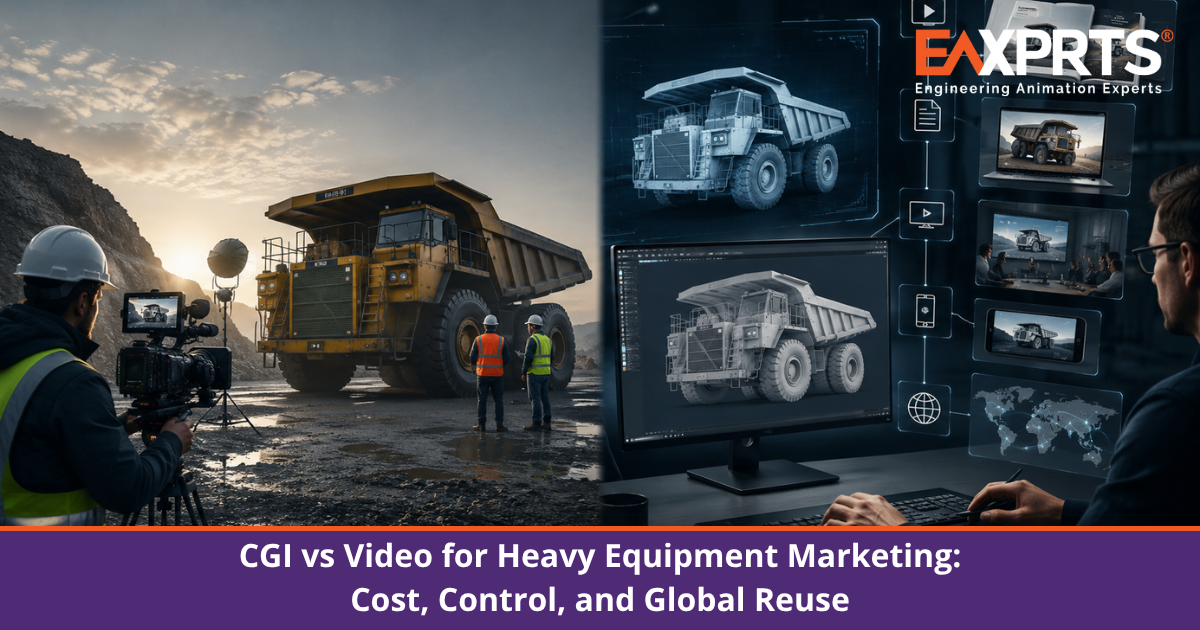
CGI vs Video for Heavy Equipment Marketing: Cost, Control, and Global Reuse
In engineering and manufacturing industries, marketing teams face a unique challenge:
How do you communicate complex, large-scale, technical products clearly, across global markets without escalating production costs or losing technical accuracy?
For decades, live-action video has been the default solution. But in heavy equipment, industrial machinery, plant systems, and engineered assemblies, traditional filming is increasingly proving inefficient, restrictive, and expensive.
In 2026, the smarter question is not “Should we use video?”
It is:
When does CGI outperform video, strategically, financially, and operationally?
This guide helps Marketing Directors, Marcom Heads, and Business Development leaders make informed decisions when choosing between live video and CGI for industrial applications.
The Industrial Marketing Reality: Filming Isn’t Always Practical
Heavy engineering products present logistical challenges that most industries do not face:
- Equipment may be installed across multiple continents
- Systems may be operational 24/7
- Filming access may require shutdowns
- Safety restrictions may limit camera placement
- Internal mechanisms cannot be shown physically
- Confidential client facilities restrict documentation
Add to that:
- Multiple product variants
- Ongoing engineering updates
- Global distributor customization
- Regulatory differences across regions
Live video becomes not only expensive but limiting.
This is where CGI (Computer Generated Imagery) becomes a strategic advantage.
What CGI Offers That Live Video Cannot
CGI is not simply “3D animation.” In industrial marketing, it is a precision-controlled visualization system that allows you to:
✔ Reveal internal components
✔ Show cutaways and section views
✔ Simulate assembly or installation
✔ Modify environments digitally
✔ Create unlimited camera angles
✔ Adjust materials and finishes
✔ Update design revisions efficiently
For engineering-driven industries, control equals clarity and clarity drives trust.
Cost Comparison: The Hidden Financial Equation
At first glance, some marketing teams assume video is cheaper.
But let’s examine the full cost structure.
Live Video Cost Factors
- Location travel
- Equipment rental
- Production crew
- Lighting setup
- Safety supervision
- Downtime or shutdown costs
- Re-filming for revisions
- New shoots for variants
- Reshoots for updated branding
Now multiply that across:
- US market
- UK/EMEA market
- India/APAC market
- Distributor customization
Costs escalate rapidly.
CGI Cost Factors
- CAD preparation
- 3D optimization
- Texturing & lighting
- Animation production
- Rendering
- Voiceover & localization
However:
✔ No location dependency
✔ No shutdown requirement
✔ No physical access risk
✔ No re-shoot logistics
✔ Easy variant adaptation
✔ Efficient revision updates
Over a 3–5 year lifecycle, CGI often results in lower cost per use.
Revision Flexibility: Where CGI Wins Decisively
Engineering products evolve.
A flange changes. A bracket updates. A housing redesign occurs. A safety feature is enhanced. With live video, even small changes can require partial or full re-filming.
With CGI:
- Update CAD
- Adjust scene
- Re-render specific shots
Modular scene architecture dramatically reduces update costs.
This is particularly important for companies expanding globally or launching multiple product variants annually.
Internal Visibility: The Ultimate Advantage
In heavy equipment and plant systems, internal differentiation is often the key sales argument.
But live video cannot:
- Enter a sealed housing
- Show internal locking mechanisms
- Demonstrate fluid flow inside pipes
- Simulate load distribution
- Reveal performance under stress
CGI can.
For engineering buyers, internal clarity builds technical confidence.
Control Over Environment & Context
Live filming requires ideal conditions:
- Clean installation
- Good lighting
- Controlled background
- Stable operation
But real industrial sites are rarely camera perfect.
CGI allows you to:
✔ Create ideal plant environments
✔ Remove visual distractions
✔ Highlight only relevant components
✔ Simulate multiple industries (oil & gas, power, automotive, manufacturing)
✔ Adjust region-specific settings
This flexibility is critical for global campaigns.
Variant Management: A Major Industrial Challenge
Manufacturers often offer:
- Multiple sizes
- Regional compliance versions
- Optional attachments
- Custom configurations
Filming each variant is impractical.
With CGI:
- Swap models
- Change textures
- Adjust dimensions
- Modify labels
The base animation structure remains intact.
This dramatically improves marketing agility.
Localization Across Global Markets
Companies targeting India, APAC, EMEA, US, and UK markets require:
- Multilingual voiceovers
- Region-specific messaging
- Distributor branding
- Regulatory labeling
With live video, localization may require re-editing footage extensively.
With CGI, you separate:
- Visual layer
- Text layer
- Voice layer
Localization becomes efficient and scalable.
When Live Video Still Makes Sense
Live video remains valuable when:
- Human interaction is central
- Real operator engagement is important
- Factory culture storytelling is required
- Customer testimonials are featured
- Corporate brand identity is being communicated
The smartest strategy is not “CGI or video.”
It is:
CGI for technical clarity. Video for human connection.
Hybrid Strategy: The Most Effective Approach
Leading manufacturing brands use a hybrid model:
- CGI for product explanation
- Video for real-world credibility
- WebXR for interactive engagement
For example:
- CGI explains the mechanism
- Video shows installation context
- Interactive WebXR allows self-exploration
This layered approach maximizes persuasion.
Strategic Deployment Channels
When deciding between CGI and video, consider deployment:
| Channel | CGI Advantage | Video Advantage |
| Website Product Page | Internal views | Real-world context |
| Trade Show LED | Clean visuals | Human engagement |
| Distributor Portal | Variant switching | Case stories |
| Technical Training | Assembly clarity | Operator behavior |
| Social Media | Eye-catching renders | Brand presence |
Marketing leaders must evaluate the asset’s lifecycle, not just its launch impact.
Long-Term Asset Reuse: The True ROI Driver
A properly structured CGI asset can be reused for:
- Website updates
- New campaign cutdowns
- Interactive WebXR conversion
- Distributor training
- After-sales support
- Maintenance guidance
This is where companies working with specialized industrial animation partners such as
EAXPRTS benefit by structuring animation assets for scalability, not one-time output.
Strategic planning at the modeling stage determines future flexibility.
Engineering Credibility & Buyer Psychology
Industrial buyers are analytical.
They respond to:
- Transparent mechanisms
- Accurate motion simulation
- Realistic material representation
- Logical assembly sequence
Over-stylized animation reduces trust.
Exaggerated lighting, unrealistic physics, or incorrect mechanical motion can undermine credibility instantly.
CGI for heavy engineering must prioritize:
✔ Engineering realism
✔ Accurate tolerances
✔ Mechanical correctness
✔ Controlled visual emphasis
Common Mistakes When Choosing Between CGI & Video
- Choosing video because “we’ve always done it”
- Underestimating revision frequency
- Ignoring global localization needs
- Not planning for interactivity
- Filming before engineering sign-off
- Overbuilding CGI without defined objective
Strategic clarity prevents expensive missteps.
Decision Framework for Marketing Leaders
Before choosing, ask:
- Will internal components need visualization?
- How many product variants exist?
- How often does engineering update?
- Will this be reused across regions?
- Do we need long-term scalability?
- Is confidentiality a concern?
- Will we later convert this into interactive WebXR?
If most answers lean toward flexibility and scalability, CGI likely offers greater long-term value.
The 2026 Industrial Marketing Imperative
Engineering and manufacturing companies are no longer competing only on product quality.
They compete on:
- Clarity
- Speed of explanation
- Digital maturity
- Sales enablement tools
- Global communication efficiency
CGI empowers industrial brands to:
- Shorten sales cycles
- Improve distributor alignment
- Enhance exhibition impact
- Strengthen technical positioning
- Reduce marketing production waste
Conclusion
Live video captures reality.
CGI controls it.
In heavy equipment and industrial systems, control often leads to clearer differentiation, stronger persuasion, and better scalability.
The most forward-thinking manufacturing marketing teams in 2026 are not abandoning video, they are deploying CGI strategically where it creates measurable advantage.
When chosen intelligently, CGI transforms engineering complexity into competitive clarity.
Talk to us today! Reach us on sales@eaxprts.com