


Physics-Based Accuracy: Why “Looking Real” Isn’t Enough for Engineers
February 17, 2026
3D Engineering Animation Best Practices: Accuracy, Clarity, and Revision Control (What Marketing Teams Must Ask For)
May 19, 2026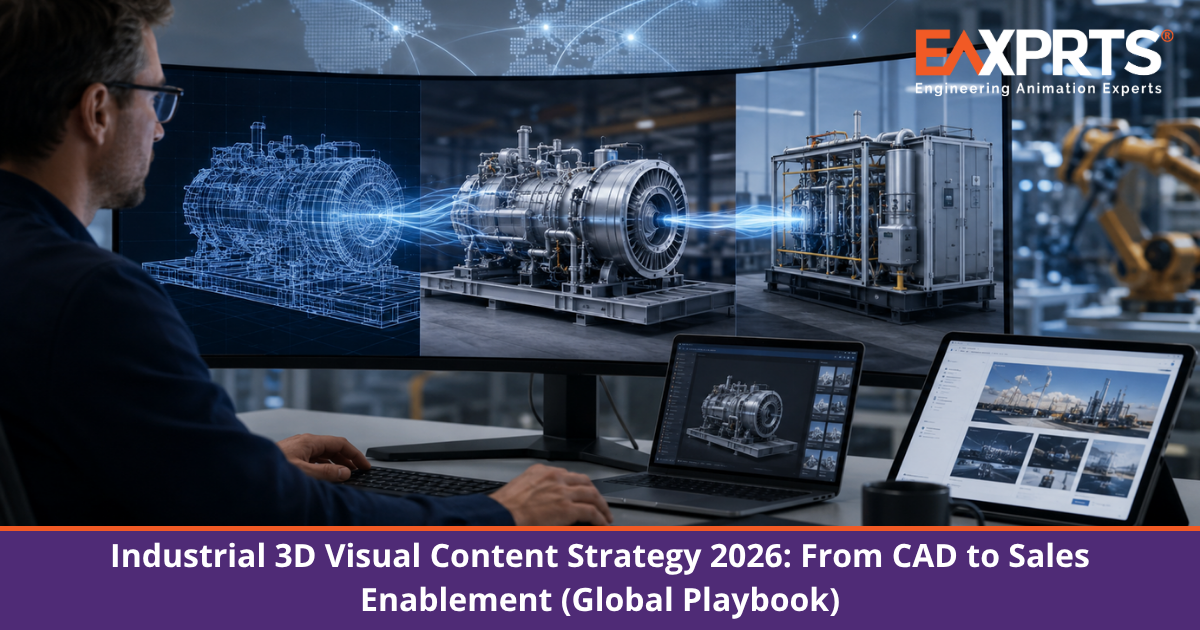
Industrial 3D Visual Content Strategy 2026: From CAD to Sales Enablement (Global Playbook)
In 2026, engineering and manufacturing companies are under increasing pressure to communicate complexity faster, clearer, and across multiple regions. Buyers expect precision. Sales teams demand differentiation. Marketing leaders must justify budgets with measurable pipeline impact.
Traditional brochures and standard product videos are no longer enough, especially when products are large, technical, customized, or installed across global facilities.
Industrial brands that are winning today are doing something different:
They are transforming engineering CAD data into scalable 3D visual ecosystems powering marketing, exhibitions, distributor training, and digital sales enablement from a single source of truth.
This playbook outlines how to build that system.
Why 3D Is Now a Strategic Asset, Not a Creative Expense
For heavy equipment manufacturers, OEMs, plant solution providers, and engineering companies, physical filming presents clear limitations:
- Equipment may be too large or geographically dispersed
- Installations may not yet be complete
- Safety restrictions limit filming access
- Product variants make video reshoots costly
- Confidential environments restrict photography
In contrast, 3D engineering animation and CGI visualization eliminate these constraints.
A single high-quality 3D asset can:
- Power trade show displays
- Support website product pages
- Enable remote sales demos
- Create distributor training modules
- Generate multilingual content for global markets
- Convert into interactive WebXR experiences
Instead of producing isolated media pieces, forward-thinking marketing teams are building reusable visual libraries that scale.
Step 1: Start with Engineering Accuracy (Single Source of Truth)
The foundation of industrial 3D strategy begins with engineering integrity.
The most effective workflows integrate directly from CAD models (SolidWorks, Solid Edge etc.) into animation-ready pipelines without losing geometric fidelity.
This ensures:
- Dimensional accuracy
- Correct assembly hierarchy
- Realistic motion simulation
- Proper mechanical relationships
- Reduced revision cycles
For marketing directors operating globally, this matters because inaccurate visuals damage credibility with technically trained buyers.
By leveraging services such as industrial 3d engineering animation you ensure that what sales shows aligns with what engineering builds.
Best Practice:
Never rebuild models from scratch unless necessary. Maintain CAD linkage to allow efficient revision updates when engineering changes occur.
Step 2: Design for the Entire Sales Funnel, Not Just Awareness
Many organizations treat animation as a top-of-funnel branding tool. That’s a missed opportunity.
An effective 3D content strategy supports all three funnel stages:
Top of Funnel – Attraction
- Product overview animations
- CGI hero visuals
- Social and website product explainers
Mid Funnel – Consideration
- Exploded views
- Assembly sequences
- Comparison animations (traditional vs advanced solutions)
- Performance simulations
Bottom Funnel – Conversion
- Installation animations
- Maintenance walkthroughs
- Interactive demos
- Custom configuration previews
By planning for funnel coverage at the outset, marketing teams multiply ROI from a single production cycle.
Step 3: When to Use CGI Instead of Video
Industrial marketing often defaults to live-action video. But for engineering products, CGI frequently delivers superior control and flexibility.
Use CGI when:
- The product is too large to film
- The installation site is confidential
- Internal mechanisms must be shown
- Multiple variants exist
- You need multilingual versions
- Environmental conditions are difficult to recreate
With CGI rendering services for manufacturing, brands gain:
- Photoreal lighting control
- Environmental flexibility
- Variant swapping without reshoots
- Future-proof asset reuse
CGI is not a replacement for all video, but for engineered systems, it often provides greater long-term value.
Step 4: Make It Interactive — Enter WebXR
Static videos limit engagement. Interactive experiences increase dwell time, engagement depth, and buyer understanding.
WebXR enables:
- Browser-based 3D product walkthroughs
- Clickable hotspots
- Variant switching
- Layer visibility toggles
- Section cuts
- Assembly exploration
- No app download required
For global business development teams operating across US, UK, EMEA, India, and APAC, WebXR offers immediate advantages:
- Shareable via link
- Accessible across devices
- Suitable for remote distributor training
- Ideal for trade shows
Best Practice:
Design animation assets so they can later be converted into interactive modules, not treated as separate projects.
Step 5: Repurpose 1 Asset into 6 Revenue Channels
One engineered 3D asset can power:
- Website product pages
- Exhibition LED displays
- LinkedIn campaigns
- Distributor sales kits
- Internal technical training
- Service & maintenance guidance
Marketing directors in global manufacturing environments must think in terms of asset ecosystems, not individual campaigns.
When done correctly, the cost per use of a 3D asset decreases dramatically.
Step 6: Align With Regional Messaging Needs
Target regions such as:
- India
- APAC
- EMEA
- US
- UK
often require:
- Multilingual voiceovers
- Local regulatory messaging
- Region-specific case studies
- Distributor-focused content
3D animation simplifies localization because:
- Only text/voice layers change
- Visual core remains intact
- No need for full re-filming
This dramatically reduces global marketing complexity.
Step 7: Reduce Revision Time with Structured Workflow
One of the biggest concerns for marketing heads is revision chaos.
To minimize friction:
- Define animation objectives clearly
- Lock engineering sign-off before rendering
- Maintain model version control
- Separate animation layers from base CAD
- Create modular scene blocks
When structured properly, revisions become updates, not rebuilds.
Step 8: Measure Performance Like a Revenue Asset
Industrial 3D content must be evaluated using business metrics:
- Sales cycle reduction
- Meeting conversion rates
- Booth engagement time
- Website dwell time
- Distributor onboarding speed
- Customer understanding improvements
Marketing Directors should align animation KPIs with revenue KPIs, not vanity metrics.
Real-World Use Cases in Engineering & Manufacturing
Industrial 3D animation is particularly powerful in:
- Heavy machinery
- Plant equipment
- Process systems
- Energy & utilities
- Automotive manufacturing
- Automation systems
- Assembly lines
- Installation systems
The Governance Layer: Scaling Globally Without Losing Control
As organizations expand, consistency becomes critical.
A scalable industrial 3D strategy includes:
- Standardized visual style guides
- Approved material libraries
- Motion templates
- Centralized asset repositories
- Clear approval workflows
This allows marketing teams across continents to deploy unified messaging.
Common Mistakes Manufacturing Brands Make
- Treating animation as a one-time exhibition tool
- Ignoring CAD integrity during conversion
- Not planning for future interactivity
- Overloading technical details without narrative clarity
- Underestimating revision governance
Avoid these, and ROI increases significantly.
Building a 2026 Industrial 3D Roadmap
Here’s a simple planning framework:
Phase 1: Audit
- Existing CAD quality
- Current marketing assets
- Sales bottlenecks
Phase 2: Define Objectives
- Awareness?
- Lead generation?
- Distributor enablement?
- Technical training?
Phase 3: Build Modular 3D Assets
- Product core model
- Exploded view
- Installation sequence
- Interactive variant
Phase 4: Deploy Across Channels
- Website
- Exhibitions
- Sales presentations
- Distributor portals
Phase 5: Measure & Optimize
Why This Matters More in 2026
Engineering buyers are digitally savvy. They expect clarity.
Procurement committees are multi-layered. They require:
- Visual proof
- Process transparency
- Functional understanding
Sales cycles are global and remote.
Industrial 3D animation bridges these gaps clearly, accurately, and persuasively.
Conclusion
In 2026, the question is no longer:
“Should we use 3D animation?”
The real question is:
“Are we using our engineering data strategically across the entire buyer journey?”
Companies that transform CAD into scalable visual ecosystems gain:
- Faster sales conversations
- Stronger distributor alignment
- Better global consistency
- Reduced marketing production waste
- Higher perceived innovation value
If you’re planning your 2026 content roadmap, now is the time to treat industrial 3D not as a creative deliverable, but as a structured business growth system.
Ready to Build Your 3D Visual Strategy?
Explore how engineering-grade visualization can support your global marketing and business development goals. Speak with our team to define a roadmap aligned with your global expansion objectives.
Talk to us today! Reach us on sales@eaxprts.com