

How to Transform Construction Communication and Training with 3D Engineering Animations
December 26, 2025
From Design to Execution: Visualizing Complex Industrial Facilities Through 3D Engineering Animations
December 29, 2025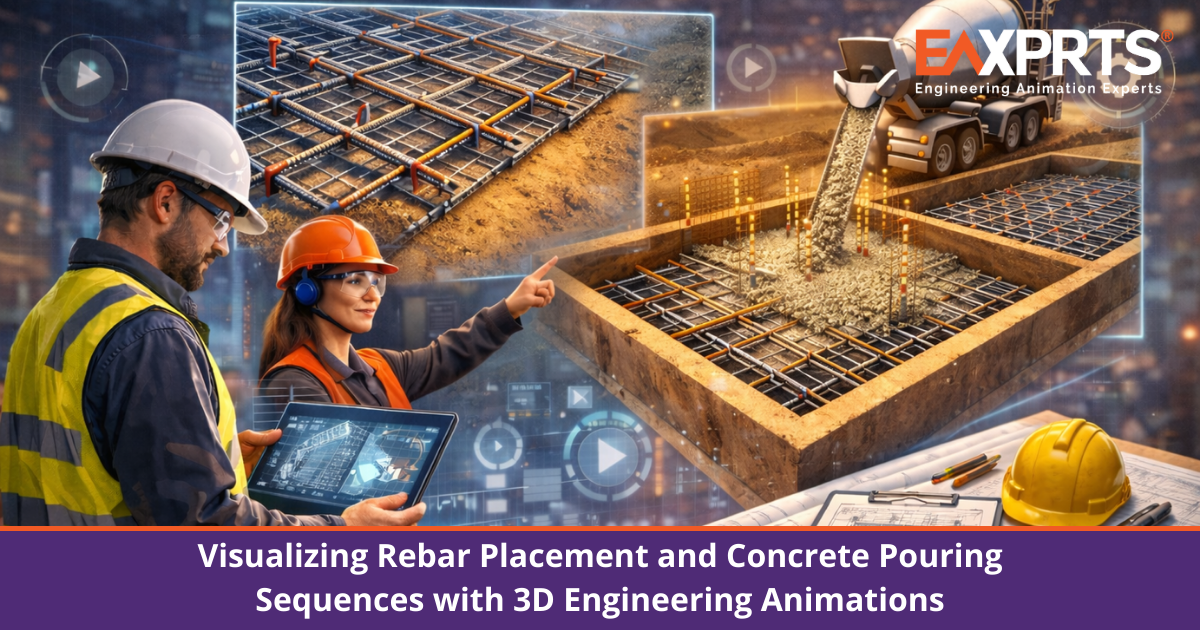
Visualizing Rebar Placement and Concrete Pouring Sequences with 3D Engineering Animations
Every successful construction project rests on precision and nowhere is precision more critical than in rebar placement and concrete pouring sequences. A single misplaced reinforcement bar or poorly sequenced pour can compromise structural strength, cause cracking, or lead to costly rework.
Yet, despite digital design tools like CAD and BIM, most construction teams still rely on 2D drawings, PDF layouts, or verbal instructions on site. This communication gap often leads to misinterpretation, unsafe practices, and delays.
This is where 3D engineering animations are reshaping the way construction teams visualize and execute these critical processes. They bridge the divide between design and field execution — turning complex details into clear, visual sequences that everyone can understand.
If you haven’t yet explored the broader advantages of animation-driven communication, read our article on transforming construction communication and training with 3D engineering animations.
The Challenge: Communicating Complex Rebar and Pouring Details
Reinforcement and concrete works demand absolute clarity. Even experienced site teams can misread drawings, overlook cover distances, or misunderstand pour sequences.
Common Challenges in Conventional Workflows:
- 2D drawings lack spatial depth: Workers struggle to visualize how overlapping bars or layered meshes fit together.
- Unclear sequencing: Misunderstanding of pour directions or lift sequences can cause cold joints or uneven compaction.
- Supervision dependency: Supervisors spend significant time explaining layouts and sequences manually.
- Safety risks: Workers unaware of safe zones during pouring or crane operations increase on-site hazards.
These issues can delay schedules, increase inspection rejections, and even lead to structural defects, all stemming from communication inefficiency, not technical incompetence.
Understanding Rebar Placement and Concrete Pouring Sequences
Rebar Placement: The Skeleton of Every Structure
Reinforcing bars (rebars) form the skeleton of concrete structures. They provide tensile strength, control cracking, and ensure long-term durability. The placement process includes:
- Cutting and bending rebar as per design
- Fixing chairs, spacers, and ties
- Ensuring correct spacing, overlap, and cover
- Conducting pre-pour inspection and approvals
In large projects such as raft foundations or structural cores, rebar layouts can become extremely dense and layered, making it hard to visualize and verify correctness.
Concrete Pouring: The Structural Binding Process
The pouring sequence determines how the rebar cage gets encapsulated within the concrete. Key stages include:
- Setting up formwork and pouring zones
- Pumping concrete layer by layer
- Compaction with vibrators
- Controlled curing and formwork removal
If the sequence is not well-coordinated, defects like honeycombing, segregation, or cold joints can occur.
That’s why visual clarity before execution is essential and 3D animation provides exactly that.
How 3D Engineering Animations Simplify Visualization
3D engineering animations use real design data (from CAD or BIM) to create dynamic, accurate, and visually realistic sequences of construction processes. These animations replicate the actual rebar installation and concrete pouring steps, showing the process in motion before it happens on site.
Key Advantages:
- Spatial Clarity and Layer Visualization
Instead of static plan views, workers can see how rebar layers stack and interact in three dimensions. They can identify overlaps, lap lengths, and intersections with embedded items, reducing errors during placement.
- Accurate Pouring Sequences
Animations demonstrate zone-by-zone pouring, showing where to start, how to proceed, and how to maintain a uniform pour direction. They can also illustrate vibration coverage, curing times, and formwork removal.
- Real-Time Coordination Across Teams
When civil, mechanical, and electrical teams see the same animation, everyone aligns on execution steps. It becomes a shared visual reference for engineers, supervisors, and workers.
- Multilingual and Inclusive Communication
No text-heavy manuals needed — workers of all skill levels can understand visual sequences intuitively, regardless of language or literacy barriers.
- Risk-Free Learning Environment
Teams can study and discuss animations before entering the site. Mistakes made virtually cost nothing, unlike real-world errors that can cause rework or safety incidents.
Application Scenarios: Where Visualization Adds Maximum Value
- Foundation and Raft Slabs
Large foundations often require multi-layer rebar meshes and staged concrete pours.
3D animations show:
- Step-by-step rebar layer installation
- Concrete pour zoning (e.g., Grid A–D)
- Proper vibration coverage and finishing methods
This helps teams plan truck arrivals, pump sequencing, and manpower allocation, resulting in faster, safer, and more uniform pours.
- Columns and Beams
For vertical and horizontal members, animations illustrate:
- Bar cage formation with ties and stirrups
- Lap splicing at correct levels
- Concrete pouring direction and continuous joint formation
These visualizations reduce confusion during formwork assembly and rebar tying, particularly in congested reinforcement zones.
- Retaining Walls and Structural Cores
Animations make it easy to visualize pouring lifts, formwork shifting, and backfill coordination.
They also highlight safe zones for workers during vertical pours and crane movements, improving site safety and productivity.
- Precast and Post-Tensioned Structures
3D animations clearly explain:
- Duct routing and tendon placement
- Tensioning and grouting sequences
- Lifting and alignment of precast segments
This ensures adherence to design tolerances and prevents costly assembly errors.
Training and Safety Benefits
- Standardized Skill Training
With animation-based modules, all workers receive consistent visual instruction, eliminating variance in training quality between shifts or locations.
- Faster Learning and Retention
According to research, visual learning improves retention by over 65% compared to textual training. Workers grasp technical concepts faster when shown in motion rather than read in manuals.
- Reduced Supervision Load
Supervisors spend less time explaining repetitive tasks. Animated visuals become the reference guide for crews, improving independence and efficiency.
- Enhanced Safety Culture
Animations demonstrate unsafe acts like, improper lifting, missing PPE, or incorrect pour posture in a controlled environment. Workers see the consequences visually, creating stronger behavioral change.
Integrating 3D Animations with Modern Construction Workflows
The real power of 3D animations emerges when integrated into digital construction ecosystems.
- BIM Integration
Animations derived directly from BIM models ensure dimensional accuracy and reflect design intent precisely.
They can visualize construction sequencing (4D simulation), highlight reinforcement congestion, and aid in clash detection between MEP and structural elements.
- WebXR and AR-Based Visualization
Through WebXR experiences, teams can view animations on-site via tablets or AR headsets.
Imagine a site engineer scanning a QR code on a column formwork and instantly viewing its rebar placement sequence in AR, eliminating uncertainty.
- Learning Management Systems (LMS)
Animated training content can be uploaded to an internal LMS. This allows organizations to:
- Track training completion and quiz results
- Issue certifications
- Maintain records of safety and skill compliance
- Cloud Collaboration
Animations can be hosted on secure cloud portals, giving global teams or clients instant access to process visuals during coordination meetings or virtual inspections.
Business Impact: From Rework Reduction to Faster Approvals
| Aspect | Before (Traditional Methods) | After (3D Animation Visualization) |
| Communication | 2D drawings often misinterpreted | Clear, step-by-step 3D visuals |
| Training | Text-based sessions; low retention | Visual modules; high retention |
| Rework | Frequent errors in bar spacing or pour order | Early clash detection and sequencing clarity |
| Safety | Limited awareness of site hazards | Visual safety reinforcement |
| Client Approvals | Manual presentations | Visual validation of construction intent |
| Productivity | Delays due to miscommunication | Streamlined execution and team alignment |
Companies adopting 3D engineering animations in rebar and concrete works report:
- Up to 40% reduction in rework costs
- 30% improvement in training efficiency
- Faster design and safety approvals due to visual validation
Case Example: Bringing Structural Clarity to Life
A major industrial construction project in India faced recurring inspection rejections for a large raft foundation due to improper rebar spacing and pouring sequences. Despite issuing updated 2D drawings, the site crew continued to misinterpret the layout.
Partnering with EAXPRTS, the project team developed a 3D engineering animation showing:
- Layer-wise rebar placement with correct cover spacing
- Sequential concrete pouring zones with compaction visuals
- PPE and safety compliance steps during each phase
The outcome was dramatic:
- Rework time reduced by 38%
- Inspection approvals completed 25% faster
- Site teams requested similar visuals for upcoming structures
This case proved that seeing is understanding and visualization transforms site execution.
Linking Back to the Bigger Picture
The rebar and concrete sequencing example is just one of many ways 3D engineering animations are transforming communication across the construction industry.
From equipment installation and commissioning to maintenance and safety training, visual communication creates a shared understanding among all stakeholders — engineers, clients, and workers alike.
Learn how 3D animation is revolutionizing overall construction communication and workforce training in our article here.
Conclusion
Rebar placement and concrete pouring demand accuracy and that accuracy begins with clear communication.
3D engineering animations give construction teams a visual blueprint of how every bar, formwork, and pour should happen reducing rework, improving safety, and saving time.
When workers can see the process before performing it, precision becomes natural, not forced. It’s time for the construction industry to move beyond 2D drawings and bring every critical process to life through 3D visualization.
Talk to us today! Reach us on sales@eaxprts.com