


Explaining Solar Power Plants with 3D Engineering Animations: From Panels to Grid
October 28, 2025
Visualizing Rebar Placement and Concrete Pouring Sequences with 3D Engineering Animations
December 29, 2025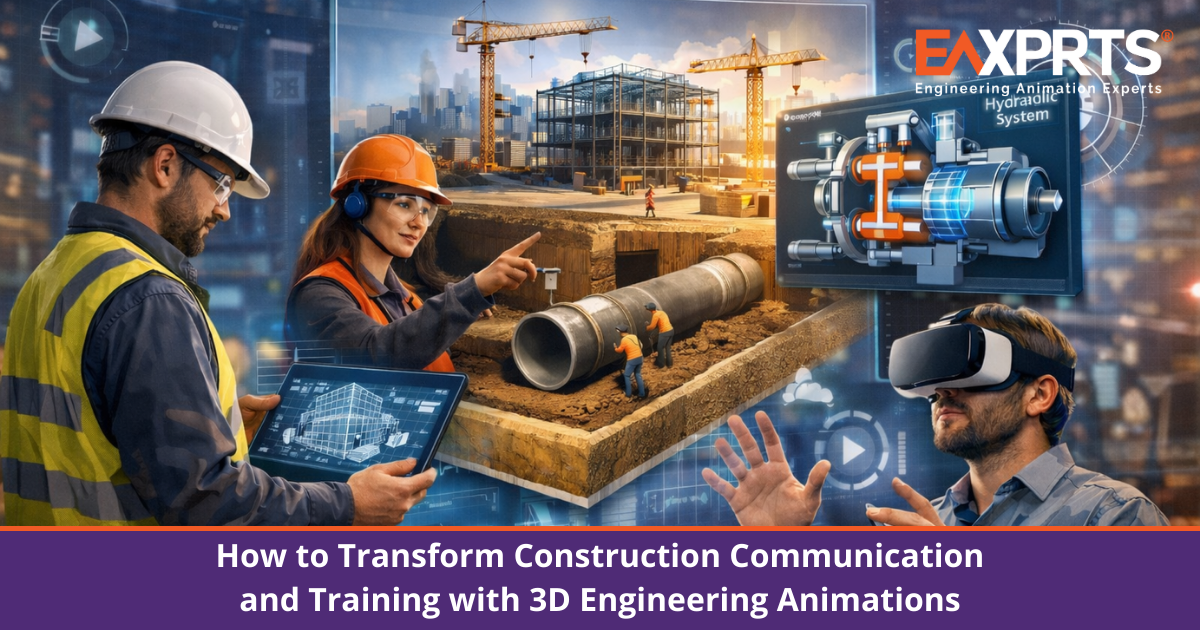
How to Transform Construction Communication and Training with 3D Engineering Animations
Construction projects are among the most complex undertakings in the industrial world involving architects, engineers, contractors, vendors, and clients across multiple geographies. Despite digital tools like BIM and CAD, many projects still suffer from miscommunication, design misinterpretation, and training inefficiencies on the job site.
A single misunderstanding between a designer and a contractor can delay entire project timelines or cause costly rework. According to a report by Autodesk and FMI, communication issues contribute to nearly 48% of all rework in construction projects.
So, how do modern construction firms eliminate ambiguity and ensure every stakeholder, from engineers to field workers, shares the same understanding of a project?
The answer lies in 3D engineering animations, a transformative way to visualize processes, explain complex designs, and train teams with unmatched clarity.
What Are 3D Engineering Animations in Construction?
3D engineering animations are high-fidelity visualizations that bring technical designs, installation sequences, and operational procedures to life. They use actual CAD or BIM data to create realistic, physics-based animations that replicate real-world construction processes.
Unlike 2D drawings or textual manuals, these animations show step-by-step visual workflows, such as how a structure is assembled, how components fit together, or how to safely perform a task.
Types of 3D Engineering Animations Commonly Used in Construction:
- Process & Installation Animations – Show construction and assembly sequences, equipment erection, and commissioning.
- Safety & Training Animations – Demonstrate correct PPE usage, crane operations, scaffolding safety, and confined space procedures.
- Maintenance & Troubleshooting Visuals – Teach technicians how to inspect, replace, or calibrate equipment.
- Virtual Site Tours – Create immersive previews of construction sites or facilities before completion.
- Visual SOPs & Work Instructions – Replace lengthy documents with visual workflows accessible from any device.
3D engineering animations are no longer limited to marketing videos — they’ve become core tools for engineering communication, digital training, and project execution.
The Communication Gap in Conventional Construction Workflows
Despite advancements in project management and BIM platforms, several issues persist in the construction ecosystem:
- Design-to-Execution Disconnect
Engineers work in CAD and 3D environments, but many site workers still rely on 2D drawings or printed blueprints. Translating complex designs into field execution creates room for error.
- Cross-Functional Misalignment
Civil, electrical, and mechanical teams often interpret the same drawing differently. Without a common visual reference, coordination suffers — leading to onsite conflicts and rework.
- Inconsistent Training
Construction sites are dynamic, with frequent workforce changes. Traditional classroom or text-based training fails to deliver consistent learning outcomes, especially for non-native language speakers.
- Inefficient Documentation
Lengthy technical manuals are difficult to follow under real-world site conditions. Most workers don’t read them, leading to reliance on supervisors for critical instructions.
How 3D Engineering Animations Bridge the Gap
3D animations transform the way construction teams communicate and train by making complex information instantly understandable.
- Simplifying Complexity
Whether it’s showing the rebar placement in a foundation or a crane’s load path during lifting, animations make complex engineering sequences visually intuitive.
- Enhancing Multilingual Communication
Visual storytelling removes language barriers. A properly designed animation can train workers in India, the Middle East, or Europe without changing a single frame of video.
- Improving Collaboration
Animations provide a shared visual language for project owners, contractors, and vendors. Everyone can visualize the same outcome — reducing misunderstandings and approval cycles.
- Real-Time Visualization of Construction Processes
Before the first brick is laid, 3D animations can show how the final structure will look, how each phase connects, and where potential bottlenecks might occur.
- Immersive Safety Training
Animated safety modules simulate accidents or unsafe practices in a risk-free environment. Workers can see consequences of unsafe behavior, reinforcing safety culture more effectively than lectures.
Key Applications in Construction
- Design and Planning Visualization
Before ground-breaking, animations enable project stakeholders to preview construction sequences and spatial layouts. By animating formwork assembly, scaffolding, or HVAC installation, planners can detect clashes or sequencing issues early.
- Site Induction and Safety Training
New workers can be trained faster using animated site orientation videos that show the dos and don’ts specific to each project. Topics like fall protection, electrical hazards, and confined space entry become easier to grasp through visuals rather than text-heavy presentations.
- Equipment Installation and Commissioning
Complex installations such as boilers, cranes, or heavy equipment can be animated step-by-step, from foundation to alignment. Technicians can learn proper torque tightening, wiring, and calibration visually, reducing dependency on supervisors.
- Maintenance and Troubleshooting
3D animations make routine maintenance visual. Instead of flipping through pages of SOPs, operators can watch an animation that demonstrates lubrication points, inspection procedures, or part replacement.
- Client Communication and Presentations
EPC and construction firms use engineering animations during tender presentations or stakeholder reviews to convey design intent. Clients appreciate visual clarity, resulting in faster approvals and stronger confidence in the project execution plan.
Case Example: Visualizing Complex Construction Projects
A leading EPC contractor faced repeated safety incidents during a boiler installation project. Despite comprehensive safety manuals, workers struggled to visualize the correct lifting sequences and safe zones.
The company collaborated with a 3D engineering animation studio to create a safety and installation sequence animation that demonstrated every crane movement, signal, and operator position.
Within two months:
- Training time reduced by 40%
- On-site incidents dropped by 25%
- Project managers reported improved cross-team communication
The animation later became part of the firm’s global safety training module, deployed across multiple projects.
This example highlights how 3D animation bridges the gap between engineering documentation and practical execution.
Integration with Modern Digital Tools
The real power of 3D engineering animations is amplified when integrated with digital construction tools and Industry 4.0 technologies.
- BIM (Building Information Modeling)
Animations created from BIM data ensure geometric accuracy and process synchronization. Engineers can simulate construction sequences directly from BIM models and validate clash-free assembly.
- Virtual Reality (VR) and WebXR
Immersive 3D training enables workers to explore virtual construction environments, identify hazards, and practice assembly tasks interactively. WebXR experiences allow remote teams to access these environments directly through a browser.
- Learning Management Systems (LMS)
Animated training modules can be hosted within an LMS, allowing HR and safety managers to track completion rates, quiz results, and competency levels.
- Cloud Collaboration
Through cloud platforms, animations can be securely shared across regions — ensuring consistent messaging and visual standards for global project teams.
Business Benefits of Adopting 3D Animations
| Benefit Area | Impact |
| Safety & Compliance | Reduction in workplace incidents and improved training retention |
| Productivity | Faster comprehension, reduced supervision, and smoother execution |
| Quality | Visual clarity minimizes errors and ensures adherence to SOPs |
| Cost & Time Efficiency | Fewer reworks, faster training rollout, and reduced project downtime |
| Employee Engagement | Visual training increases retention by 65% compared to text-based learning |
Additionally, construction companies report higher client satisfaction, as animations bring transparency and confidence to project presentations.
Implementing 3D Animation in Your Organization
Step 1: Identify Key Use Cases
Start by pinpointing the communication or training bottlenecks in your current workflow — for example, recurring safety issues, installation misinterpretations, or manual training dependency.
Step 2: Gather Engineering Data
Provide your animation partner with available CAD, 3D, or BIM models, along with process flow diagrams or SOPs.
Step 3: Define Objectives
Clarify whether your animation is meant for training, presentation, or operation support. The level of technical detail and narration will vary accordingly.
Step 4: Develop and Review Storyboards
Professional animation teams will create storyboards mapping each process step, ensuring technical accuracy before production.
Step 5: Integrate with Existing Systems
Deploy animations on your internal LMS, intranet, or WebXR portal. Ensure multilingual subtitles or voiceovers for broader workforce accessibility.
Step 6: Measure Impact
Track KPIs such as training completion rates, incident reduction, or time saved in client communication. Use these metrics to measure ROI and justify scaling the initiative.
Common Myths About 3D Animations
Myth 1: “3D animations are too expensive for training.”
Reality: Compared to the cost of rework or accidents, 3D animations offer a high ROI. Once created, they can be reused indefinitely across projects and sites.
Myth 2: “We don’t have 3D models.”
Modern studios can recreate accurate models from photographs, drawings, or PDFs. You don’t need to start with a complete 3D database.
Myth 3: “Our workers won’t understand it.”
In fact, visual learning is universally effective — especially for blue-collar teams. Animations simplify even the most technical procedures.
Myth 4: “It’s only for marketing.”
While 3D animations do enhance presentations, their true power lies in training, communication, and safety awareness, directly impacting productivity and compliance.
Future Trends in Construction Visualization
The future of 3D engineering animation is closely aligned with digital transformation in construction:
- AI-Assisted Animation Generation – Automated 3D animation creation directly from CAD or BIM files.
- Interactive Digital Twins – Integrating real-time IoT data with animated visual models for predictive maintenance and remote monitoring.
- Web-Based Immersive Learning – WebXR and VR-based training accessible without specialized hardware.
- Cloud Collaboration & Simulation Platforms – Centralized access to project visuals, analytics, and training tools.
As these technologies converge, 3D animations will become the visual foundation of Construction 4.0.
Conclusion
Construction success depends on clarity — clarity in communication, training, and execution. 3D engineering animations transform how construction professionals visualize, learn, and collaborate.
By converting complex engineering data into engaging, multilingual visual experiences, companies can reduce risk, accelerate training, and enhance productivity across every stage of the project lifecycle.
In an industry where time, safety, and precision matter, seeing truly is believing.
Talk to us today! Reach us on sales@eaxprts.com