Turning Complexity Into Clarity: The Role of 3D Engineering Animation in Oil & Gas Process Understanding
January 7, 2026
Transformational Benefits of 3D Engineering Animation for Engineering Teams, Operators, and Leadership
January 7, 2026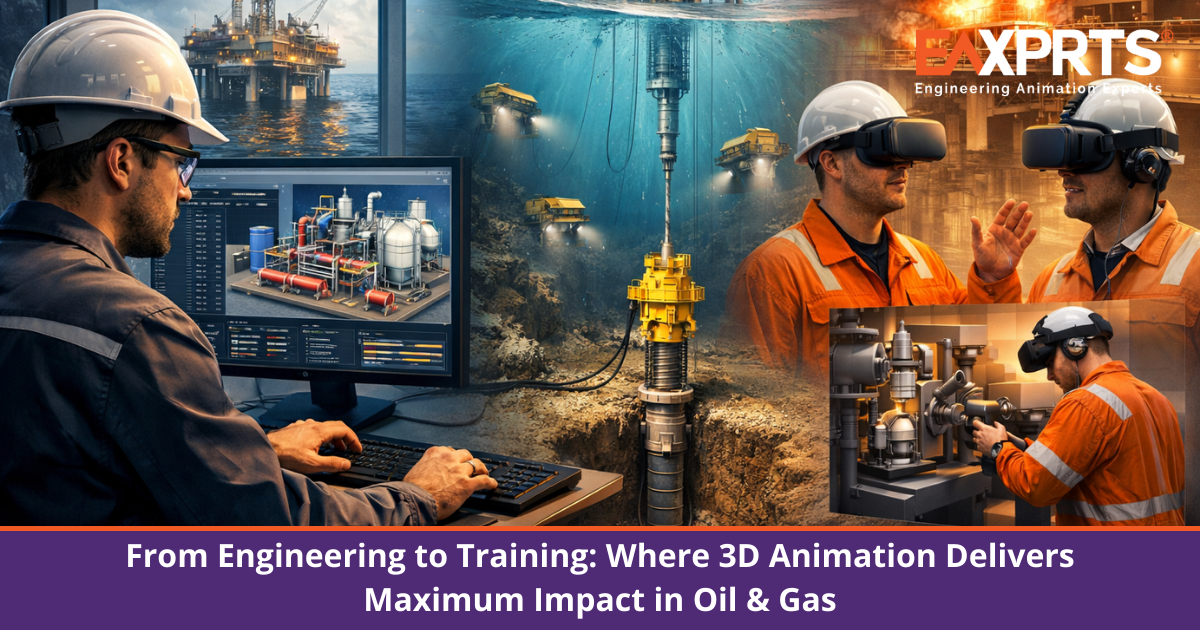
From Engineering to Training: Where 3D Animation Delivers Maximum Impact in Oil & Gas
Oil & Gas facilities operate on enormous technical complexity, where thousands of components, mechanical, electrical, process, safety, and automation systems must work together flawlessly. Communicating how these systems function, how they should be constructed, and how they must be operated has always been one of the biggest challenges for engineering teams, EPCs, operators, OEMs, and HSE departments.
Over the past decade, 3D engineering animation has evolved from a niche visualization tool into a mission-critical asset across the Oil & Gas project lifecycle. It provides clear, accurate, and intuitive storytelling for processes that are otherwise difficult or impossible to explain using only drawings, P&IDs, SOPs, or text-heavy manuals.
This blog explores the most impactful applications of 3D animation across engineering, construction, operations, safety, and training, demonstrating why global Oil & Gas companies are rapidly integrating animation into their workflows.
Why 3D Engineering Animation Matters in Oil & Gas
Oil & Gas stakeholders deal with:
- Complex multi-step engineering processes
- High-risk operating environments
- Massive project scales
- Multinational teams with varied technical expertise
3D animation becomes a universal language clear, visual, and precise, allowing every stakeholder to instantly understand what is happening in a system, how it should behave, and what must happen next.
Applications Across the Oil & Gas Value Chain
3D animation delivers high value across upstream, midstream, and downstream operations. Below are some of the strongest application categories.
- Upstream Applications
Exploration and production involve high pressure, high temperature, and constantly changing subsurface conditions. Animation clarifies:
Wellhead Operations
- Visualizing casing, tubing, safety valves, and flow direction.
- Understanding pressure containment and failure scenarios.
Artificial Lift Methods
- ESP functionality and failures.
- Gas lift animation showing injection, lift gas flow, and production rise.
Separation & Dehydration
- 2-phase / 3-phase separation
- TEG dehydration and regeneration
- Heater-treater performance visualization
Flow Assurance
- Wax deposition and hydrate formation
- Pigging sequences for pipelines
- Temperature/pressure management techniques
In upstream environments where live demonstration is impossible, animation is the safest method to train and align teams.
- Midstream Applications
Midstream operations rely heavily on continuous flow, mechanical reliability, and pipeline integrity. Animation clarifies:
Pipeline Operation and Pigging
- Launching and receiving pigs
- Cross-sectional flow behaviour
- Removing deposits and maintaining throughput
Compressor Stations
- Suction → compression → discharge cycle
- Knock-out drums, inter-stage cooling, surge events
- Anti-surge logic and safety controls
Storage Terminals
- Tank farm operations
- Overfill protection, vapor control, firefighting systems
- Blending and transfer operations
Metering Skids
- Flow measurement principles: turbine, ultrasonic, coriolis
- Proving and calibration procedures
Animation makes these interconnected systems easy to understand for engineers, contractors, and operators.
- Downstream Applications
Refining, processing, and petrochemical plants involve high temperatures, critical reactions, and precise control logic. Animation has powerful applications here:
Distillation & Fractionation
- Vapor–liquid equilibrium
- Reflux ratio and tray interaction
- How product purity is controlled
Cracking, Reforming & Reaction Processes
- Catalyst behaviour
- Temperature/pressure reactions
- Heat integration visuals
Heat Exchanger Operation
- Shell-and-tube flow patterns
- Fouling visualization
- Counterflow vs. parallel flow
Gas Sweetening & Treatment
- Amine absorption and regeneration
- H₂S / CO₂ removal
- Sulfur recovery units
LNG Liquefaction & Regasification
- Cryogenic heat exchange
- Liquefaction cycles
- Vapor return and pressure control
These processes are highly abstract on paper; animation brings them to life.
High-Impact Use Cases Across Departments
3D animation is not limited to one area. It becomes valuable for:
- Engineering
- Operations
- Safety & HSE
- Training
- Commissioning
- Sales & OEM marketing
Below are the most powerful uses:
- Process Animation for Engineering Design
During FEED, detailed engineering, and vendor discussions, animations:
- Show exactly how systems will behave
- Help identify design issues early
- Improve P&ID interpretation
- Support communication with EPC contractors
- Reduce misunderstandings between process, mechanical, and instrumentation teams
Process animations are now commonly used in design reviews and HAZOP meetings.
- Safety & Hazard Communication
Oil & Gas environments are high-risk, and many hazards cannot be demonstrated physically. Animation fills this safety-critical gap.
Animations can visualize:
- Leak dispersion and ignition
- Pressure surges
- Overfill conditions
- ESD system activation
- Fire and explosion spread
- LOTO procedures
- Confined space entry hazards
Benefits for HSE:
- Higher retention compared to lectures
- Uniform training across shifts and sites
- Improved compliance
- Reduced human error
Safety communication becomes stronger, clearer, and more impactful.
- Operator & Technician Training
Operators often struggle to understand the internal mechanisms of equipment. 3D animation makes it intuitive:
Training for
- Startup & shutdown sequences
- Troubleshooting flows
- Alarm behaviours
- Manual vs. automatic mode transitions
Ideal for
- New operator induction
- Multi-lingual teams
- Crew rotation across facilities
- Competency management programs
Operators don’t just memorize SOPs. They understand why each step matters.
- Construction Sequencing & Commissioning
Large industrial projects involve hundreds of installation steps. Animation helps coordinate teams and avoid errors.
Construction animation visualizes:
- Module lifting and placement
- Equipment alignment
- Pipe-rack assembly
- Electrical and instrumentation routing
- 4D scheduling with time-lapse installation
Commissioning animation shows:
- Mechanical completion steps
- Pre-commissioning workflows
- Utilities startup
- System-by-system activation
This prevents rework and accelerates readiness.
- Maintenance & Troubleshooting
Maintenance teams often lack visibility of internal parts. Animation demonstrates:
- Disassembly and reassembly sequences
- Bearing replacements
- Seal failures
- Rotating equipment overhaul
- Inspection and lubrication routines
- Failure modes and root cause analysis
This improves maintenance accuracy and reduces downtime.
- OEM Product Marketing for Oil & Gas
Oil & Gas OEMs use animation to:
- Demonstrate equipment working principles clearly
- Explain features that text or photos cannot show
- Stand out during exhibitions and tender submissions
- Support global sales with multilingual visuals
Examples include:
- Pumps
- Compressors
- Valves
- Filters and separators
- Analyzer systems
- Safety devices
Technical products become easier to understand, improving customer confidence.
The Future of 3D Animation in Oil & Gas
As the industry modernizes, animation is extending into advanced digital tools.
WebXR-Based Facility Walkthroughs
- Browser-based virtual tours without special hardware
- Remote team training
- Interactive learning with hotspots
AR/VR Training Simulations
- Immersive safety experiences
- Equipment handling practice
Training & SOP Generation
- Generate troubleshooting visuals
- Instant hazard animations based on scenarios
Conclusion
3D engineering animation has become one of the most valuable communication tools in the Oil & Gas industry. From upstream exploration to refinery operations and LNG systems, animation turns deeply technical processes into accessible, accurate visual explanations.
It enhances engineering clarity, accelerates design decisions, strengthens safety behaviour, and transforms operator training. Moreover, it enables faster construction alignment, smoother commissioning, and more effective OEM marketing.
In an industry where precision and safety are essential, 3D animation is no longer optional, it is an operational necessity that adds value across every stage of the Oil & Gas lifecycle.
Talk to us today! Reach us on sales@eaxprts.com