
Industrial 3D Visual Content Strategy 2026: From CAD to Sales Enablement (Global Playbook)
May 19, 2026
CGI vs Video for Heavy Equipment Marketing: Cost, Control, and Global Reuse
May 19, 2026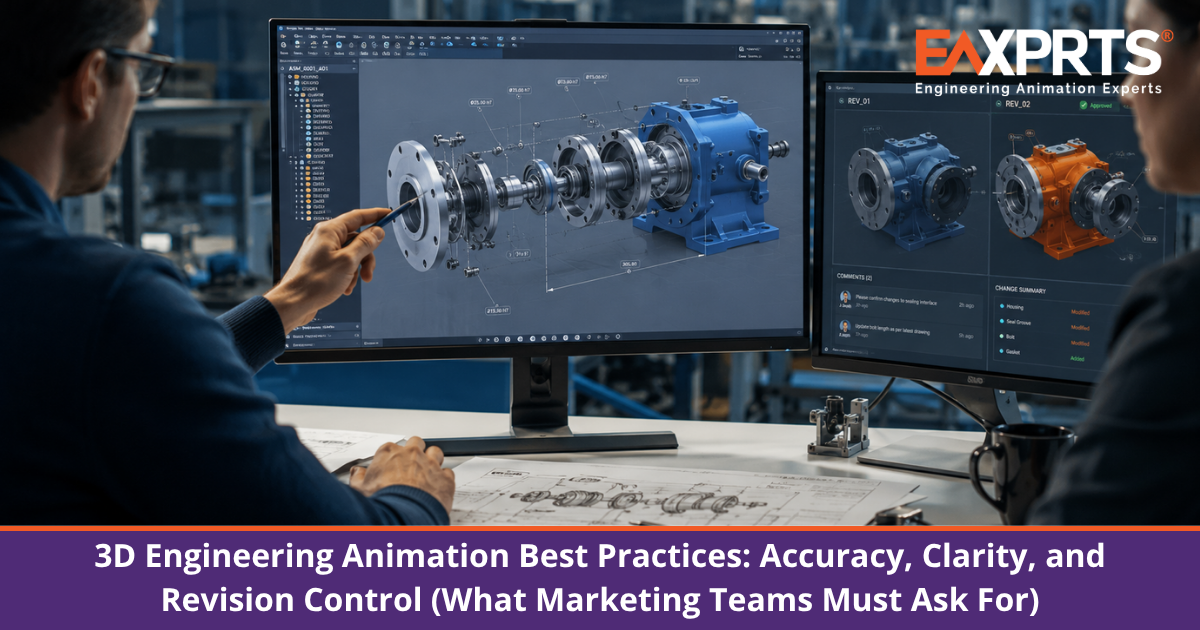
3D Engineering Animation Best Practices: Accuracy, Clarity, and Revision Control (What Marketing Teams Must Ask For)
In engineering and manufacturing industries, credibility is everything.
Your buyers are not casual consumers. They are plant managers, technical evaluators, engineering heads, procurement committees, and safety officers. They scrutinize dimensions. They question tolerances. They validate mechanical relationships. They compare assemblies.
When your marketing team invests in 3D engineering animation, the output must do more than look impressive. It must be technically accurate, strategically structured, and operationally scalable.
Yet many industrial brands approach animation as a creative exercise rather than an engineering extension.
This guide outlines the best practices manufacturing marketing teams should demand to ensure their 3D engineering animation delivers clarity, reduces revisions, and accelerates sales.
Start with Engineering-Grade Accuracy, Not Artistic Interpretation
Industrial 3D animation begins with CAD integrity.
Whether your organization uses SolidWorks, Creo, Solid Edge, CATIA, or Inventor, the 3D pipeline must preserve:
- True dimensions
- Assembly hierarchy
- Part relationships
- Kinematic motion
- Mechanical constraints
If animation teams “rebuild” models loosely for speed, inaccuracies inevitably surface later, usually during internal review or worse, during client presentations.
Best Practice: Maintain CAD Fidelity
Marketing teams should confirm:
- CAD files are used as the base source
- Geometry is optimized but not altered dimensionally
- Part naming conventions are preserved
- Engineering team signs off before final rendering
When properly structured, engineering animation becomes an extension of product design, not a separate marketing artifact.
Define the Objective Before Animating Anything
One of the most common mistakes marketing departments make is jumping into animation production without clearly defining purpose.
Ask these questions first:
- Is this asset for awareness, sales enablement, or technical clarification?
- Will it be used at trade shows?
- Will it support distributor training?
- Should it later convert into an interactive WebXR demo?
- Does it need multilingual adaptability?
Without defined objectives, animation becomes visually attractive but strategically misaligned.
Best Practice: Create an Animation Brief
Your internal brief should include:
- Target audience (engineer vs procurement vs operator)
- Primary business objective
- Key product differentiators
- Mandatory technical details
- Desired runtime
- Deployment channels
- Future reuse possibilities
This reduces misalignment and revision cycles dramatically.
Balance Technical Detail with Narrative Clarity
Engineering products are complex. But complexity does not require confusion.
Effective 3D engineering animation simplifies without oversimplifying.
Instead of overwhelming viewers with every bolt and bracket, structure the narrative using a logical flow:
Feature → Function → Outcome
For example:
- Show the locking mechanism
- Demonstrate how it prevents loosening
- Highlight reduction in downtime
Clarity increases persuasion.
Best Practice: Layer Information
Design animation in layers:
Layer 1: High-level overview
Layer 2: Exploded component explanation
Layer 3: Performance simulation
Layer 4: Installation clarity
This structure ensures viewers absorb information progressively.
Use Exploded Views Intelligently
Exploded views are powerful, but only when purposeful.
Common errors include:
- Over-exploding assemblies unnecessarily
- Separating components without logic
- Ignoring motion realism
- Failing to maintain spatial relationships
Effective exploded views:
- Follow assembly order
- Maintain axis alignment
- Reflect real installation sequence
- Highlight critical differentiators
When structured correctly, exploded animation reduces technical explanation time significantly during sales conversations.
Prioritize Revision Control from Day One
Revision chaos is the single biggest cost driver in industrial animation projects.
Engineering products evolve. Marketing copy changes. Sales wants updates. New variants are released.
Without revision governance, animation becomes expensive and time-consuming.
Best Practice: Modular Scene Architecture
Request modular builds:
- Separate animation sequences by chapter
- Isolate text layers
- Separate voice-over from visuals
- Maintain individual scene files
This enables partial updates instead of complete rebuilds.
Marketing leaders should confirm:
- What happens when CAD updates?
- How quickly can revisions be implemented?
- Is there version tracking?
- Is the asset future-proofed?
Structured animation reduces lifecycle cost.
Plan for Multi-Channel Deployment
Industrial animation should never be built for a single platform.
Consider where it will be used:
- Website product page
- LinkedIn campaign
- Exhibition LED screen
- Sales presentation
- Distributor portal
- Training environment
Design decisions such as resolution, pacing, and aspect ratio must align with deployment.
For interactive planning, consider early WebXR adaptation:
When marketing teams plan multi-channel deployment early, ROI multiplies.
CGI Integration for Engineering Visualization
Sometimes live video cannot capture the necessary clarity — especially for internal components.
In such cases, CGI rendering enhances storytelling.
Effective CGI should:
- Maintain material realism
- Use accurate lighting
- Reflect actual product finishes
- Avoid exaggerated textures
For industrial environments, realism builds trust.
CGI is particularly powerful for:
- Cross-sectional views
- Environmental simulations
- Before/after comparisons
- Future-state visualizations
Ensure Engineering Sign-Off Before Final Rendering
Marketing teams must institutionalize engineering review checkpoints.
Suggested workflow:
- CAD validation
- Low-resolution preview render
- Motion test review
- Technical approval
- Final render
Skipping review stages causes expensive rework.
Engineering sign-off ensures credibility with technical buyers.
Design for Longevity, Not Just Launch
Too often, animation is built for a product launch and forgotten.
Instead, build assets designed for:
- 3–5 year lifecycle
- Variant adaptability
- Modular updates
- Training reuse
Ask your animation partner:
- Can we reuse this core model later?
- Can this convert into interactive?
- Can we extend this into XR?
- Can we isolate scenes for short-form clips?
Longevity dramatically improves cost efficiency.
Measure Performance Strategically
Industrial 3D animation should support measurable business outcomes.
Track:
- Reduction in sales explanation time
- Increased booth engagement
- Higher website dwell time
- Improved distributor clarity
- Shortened sales cycles
Marketing directors should connect animation investments directly to revenue enablement.
Common Pitfalls Manufacturing Brands Must Avoid
- Treating animation as decorative
- Ignoring CAD structure
- Not defining objectives
- Overloading detail without narrative
- Failing to modularize
- Skipping engineering review
- Designing for one channel only
Avoiding these mistakes transforms animation into a strategic asset.
The Strategic Advantage of Getting It Right
When 3D engineering animation follows best practices, the benefits extend beyond marketing:
- Sales gains clarity
- Engineering gains confidence
- Distributors gain training support
- Clients gain understanding
- Brand perception strengthens
In complex industrial markets across India, APAC, EMEA, US, and UK, technical clarity becomes competitive advantage.
Conclusion
Industrial 3D engineering animation is not about visual polish.
It is about:
- Accuracy
- Structure
- Clarity
- Scalability
- Governance
Marketing teams that demand these standards build assets that drive revenue, not just impressions.
If your organization is planning product launches, exhibitions, or global expansion in 2026, ensure your 3D engineering animation is built correctly from the foundation.
Ready to Elevate Your Engineering Visual Strategy?
Explore:
3D Engineering Animation: https://www.eaxprts.com/3d-engineering-animation/
CGI Rendering Services: https://www.eaxprts.com/cgi-rendering-services/
WebXR Interactive Experiences: https://www.eaxprts.com/webxr/
Or schedule a strategic discussion: https://www.eaxprts.com/contact-us/
Talk to us today! Reach us on sales@eaxprts.com