

3D Engineering Animation for Hydrogen, Carbon Capture, and Power-to-X Technologies
February 2, 2026
From CAD to Digital Twin: How Omniverse and OpenUSD Are Redefining Engineering Visualization
February 17, 2026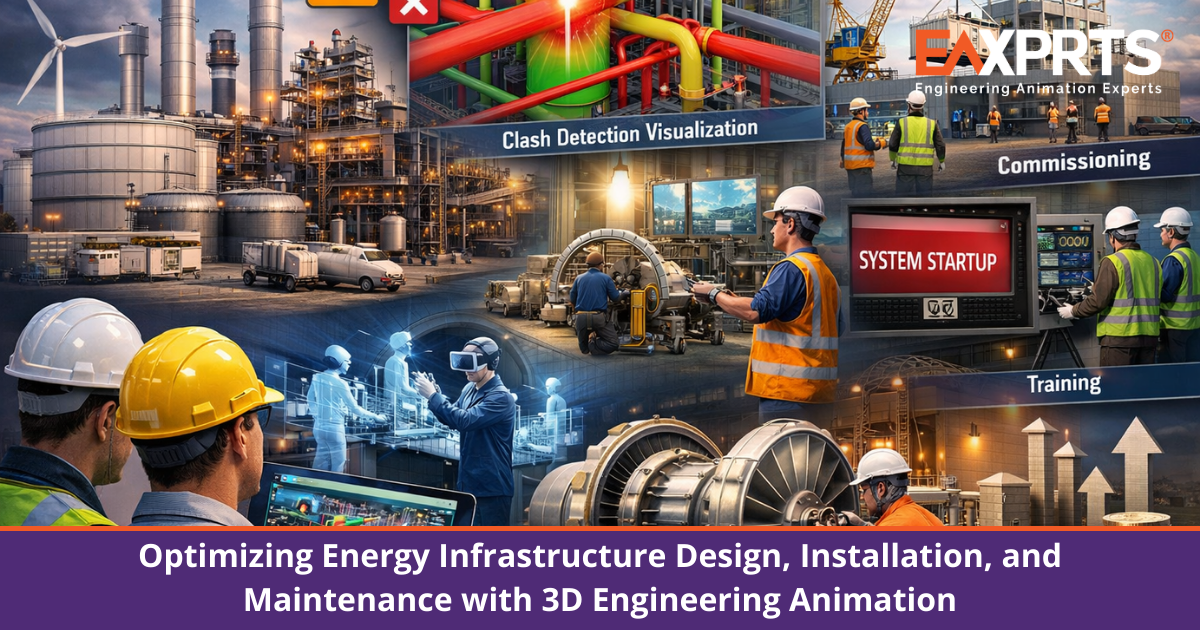
Optimizing Energy Infrastructure Design, Installation, and Maintenance with 3D Engineering Animation
Energy infrastructure projects, whether renewable plants, hydrogen facilities, grid substations, or energy retrofits, operate under intense pressure. Tight schedules, capital constraints, safety requirements, and long asset lifecycles leave little room for ambiguity or rework. While engineering tools and standards continue to evolve, one challenge remains constant: clearly aligning design intent with real-world execution.
This is where 3D engineering animation has emerged as a critical enabler. When used correctly, it becomes a visual extension of engineering, supporting design validation, construction planning, commissioning, operations, and long-term asset management.
Energy infrastructure is not built once and forgotten. It is designed, constructed, commissioned, operated, maintained, upgraded, and often retrofitted over decades. Each phase introduces new stakeholders, risks, and decisions that must be made with incomplete information.
Traditional engineering deliverables, drawings, schedules, method statements, and manuals are necessary, but they often fail to communicate sequence, spatial constraints, and system behaviour in a way that is immediately actionable for all teams involved.
3D engineering animation bridges this gap by translating engineering data into clear, time-based visual narratives that support the entire infrastructure lifecycle.
Energy Infrastructure Lifecycle Challenges
Fragmented Understanding Across Project Phases
Energy projects transition through multiple phases. Each phase involves different teams, design engineers, construction contractors, commissioning specialists, operators, and maintenance crews. Knowledge is often transferred through documents that lack continuity, leading to:
- Misinterpretation of design intent
- Loss of context between phases
- Increased reliance on assumptions
Scale, Complexity, and Long Asset Life
Energy infrastructure assets are:
- Physically large and spatially constrained
- Technically complex and multi-disciplinary
- Designed for 20–40 years of operation
Small design misunderstandings can propagate into large operational inefficiencies or safety risks over time.
Cost and Schedule Sensitivity
Delays in installation, commissioning, or maintenance can have disproportionate financial impact due to:
- Lost generation revenue
- Contractual penalties
- Extended shutdowns
Reducing uncertainty early has a direct and measurable business value.
Layout Planning & Clash Detection Visualization
Beyond Static Clash Reports
While modern tools support clash detection, clash reports alone do not always communicate:
- Severity and accessibility of clashes
- Constructability implications
- Sequence-related conflicts
3D engineering animation contextualizes these clashes spatially and temporally.
Visualizing Spatial Constraints
Animation helps teams understand:
- Equipment clearances and access paths
- Cable routing and pipe rack congestion
- Interference between civil, mechanical, and electrical systems
Instead of reviewing abstract clash IDs, teams can visually walk through the layout and assess real-world feasibility.
Supporting Multi-Discipline Design Reviews
Animated layout walkthroughs enable:
- Faster design reviews
- Better coordination between disciplines
- Earlier resolution of conflicts
This directly reduces late-stage design changes and site-level improvisation.
Layout visualization challenges are especially critical in renewable plants and hybrid systems, as discussed in the previous blog on explaining renewable energy systems using 3D engineering animation.
Installation Sequencing & Commissioning Animations
Making Construction Sequence Explicit
Energy infrastructure installation is rarely linear. Equipment deliveries, civil readiness, lifting constraints, and temporary works must be carefully coordinated.
3D engineering animation can clearly illustrate:
- Installation order of major equipment
- Crane movements and lifting envelopes
- Temporary supports and access platforms
- Interface points between contractors
This transforms installation planning from a document-heavy exercise into a visual process.
Reducing On-Site Surprises
Many construction delays arise when teams encounter:
- Access conflicts
- Undocumented spatial constraints
- Unclear handover boundaries
Animated installation sequences allow teams to anticipate and resolve these issues before arriving on site.
Commissioning Logic and System Interdependencies
Commissioning energy systems involves complex interdependencies:
- Electrical energization sequences
- Control system validation
- Safety interlock testing
3D animation helps explain:
- What must be commissioned first, and why
- System readiness dependencies
- Normal vs abnormal commissioning scenarios
This is particularly valuable for first-of-a-kind plants and next-generation technologies.
Commissioning complexity is a recurring theme in hydrogen, carbon capture, and Power-to-X projects discussed in the corresponding blog.
Maintenance, Shutdown & Retrofit Visualizations
Maintenance Is Where Design Decisions Are Truly Tested
Many design decisions only reveal their consequences during maintenance:
- Limited access
- Poor isolation points
- Inefficient component replacement paths
3D engineering animation allows maintenance scenarios to be evaluated visually before the plant is built or before retrofits are executed.
Planned Shutdown and Turnaround Visualization
Shutdowns are high-risk, time-critical events. Animation supports:
- Step-by-step shutdown sequencing
- Equipment isolation and lockout logic
- Movement of large components during maintenance
This helps reduce downtime and improve safety outcomes.
Retrofit and Upgrade Planning
Energy infrastructure is rarely static. Grid upgrades, capacity expansions, and emissions retrofits are increasingly common.
Animations help stakeholders understand:
- How new systems integrate with existing assets
- Temporary works required during retrofit
- Impact on ongoing operations
This is particularly important for carbon capture retrofits and grid modernization projects.
Training & Knowledge Transfer Use Cases
Addressing Workforce Transitions
Energy infrastructure often outlives the teams that built it. Over decades, institutional knowledge is lost due to retirements, role changes, and contractor turnover.
3D engineering animations provide:
- Consistent, repeatable training material
- Visual explanation of system behaviour
- Faster onboarding for new personnel
Training for Normal and Abnormal Scenarios
Animations are effective for:
- Explaining normal operating states
- Demonstrating failure modes
- Practicing emergency response logic
This is especially valuable for high-risk systems involving high voltage, pressure, or hazardous materials.
Supporting Digital Asset Management
When integrated into digital asset platforms, animations become:
- Visual SOP references
- Contextual learning tools
- Part of a broader digital twin strategy
Measurable Benefits for EPCs & Plant Owners
For EPCs
3D engineering animation helps EPCs:
- Reduce rework and change orders
- Improve coordination across contractors
- Strengthen client confidence
- Deliver projects more predictably
Animations also support competitive differentiation during bids by clearly communicating execution capability.
For Plant Owners and Utilities
Owners benefit through:
- Faster approvals and commissioning
- Safer operations
- Lower lifecycle maintenance costs
- Better long-term knowledge retention
These benefits compound over the life of the asset.
Quantifiable Impact
While benefits vary by project, organizations commonly report:
- Fewer site queries and RFIs
- Reduced installation delays
- Improved safety performance
- Shorter learning curves for operators
Conclusion
Energy infrastructure success is determined not just by how well systems are designed, but by how effectively those designs are executed, operated, and sustained over time. As projects grow more complex and timelines tighten, relying solely on static documentation introduces unnecessary risk.
3D engineering animation transforms engineering intent into shared understanding and supporting better decisions at every stage of the infrastructure lifecycle. It is no longer a supplementary deliverable, but a strategic capability for organizations committed to reliable, safe, and future-ready energy infrastructure.
For a comprehensive overview of how 3D engineering animation supports energy and green tech projects from concept to long-term operations, revisit the blog: Visualizing Energy & Green Tech Systems with 3D Engineering Animation.
Related Blogs:
- Explaining Renewable Energy Systems Using 3D Engineering Animation
- 3D Engineering Animation for Hydrogen, Carbon Capture, and Power-to-X Technologies
Talk to us today! Reach us on sales@eaxprts.com