

Explaining Renewable Energy Systems Using 3D Engineering Animation: Wind, Solar, and Hybrid Plants
February 2, 2026
Optimizing Energy Infrastructure Design, Installation, and Maintenance with 3D Engineering Animation
February 2, 2026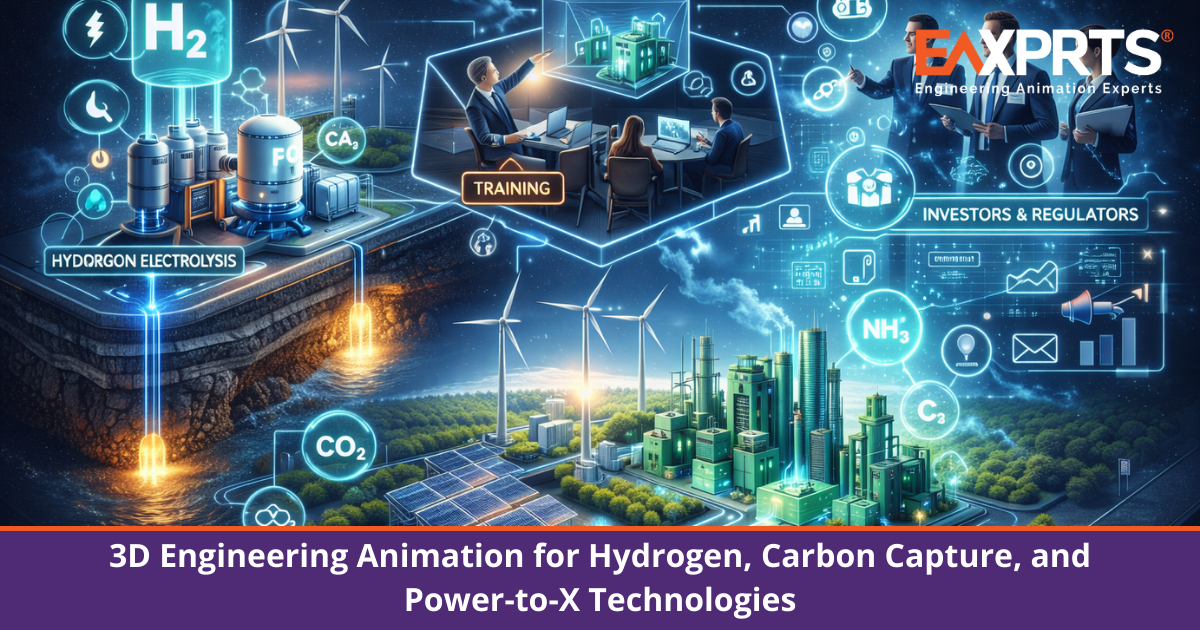
3D Engineering Animation for Hydrogen, Carbon Capture, and Power-to-X Technologies
Next-generation green technologies such as hydrogen production, carbon capture, and Power-to-X are central to global decarbonization strategies. Governments are funding them, utilities are planning them, and investors are actively evaluating them. Yet these systems remain technically dense, unfamiliar, and often misunderstood, even by experienced industrial stakeholders.
Unlike conventional power generation or process plants, many of these technologies are still evolving. They combine electrochemistry, thermodynamics, high-pressure systems, digital control, and renewable energy integration in ways that challenge traditional modes of technical communication. This is where 3D engineering animation becomes essential, not as a marketing layer, but as a practical tool for explanation, validation, and trust-building.
The Visualization Challenge in Next-Gen Green Technologies
Hydrogen, carbon capture, and Power-to-X technologies share a common problem: complexity without familiarity.
High Technical Density, Low Stakeholder Intuition
These systems involve:
- Electrochemical reactions inside stacks and cells
- High-pressure gas handling and compression
- Heat management and cooling loops
- Integration with variable renewable power
- Safety systems designed for rare but high-impact events
Unlike turbines or boilers, many stakeholders have no intuitive mental model for how these systems work. Process flow diagrams and datasheets are technically accurate, but they do little to help non-specialists visualize behavior, risk, or integration.
Multi-Disciplinary and Modular by Nature
Most next-gen green tech plants are:
- Modular (skids, stacks, containerized systems)
- Highly integrated with balance-of-plant utilities
- Designed for phased expansion
Understanding how these modules interact spatially and functionally, is difficult without visualization.
High Scrutiny from Investors and Regulators
Because these technologies are capital-intensive and relatively new, they face:
- Extended due diligence cycles
- Conservative safety reviews
- Detailed questions on operability and maintainability
Clear visualization can significantly reduce uncertainty and accelerate confidence.
Hydrogen Electrolysis: Process Flow & Safety Visualization
Hydrogen electrolysis plants are at the center of green hydrogen strategies, yet they remain poorly understood outside specialist engineering circles.
Visualizing the Electrolysis Process
3D engineering animation can clearly illustrate:
- Water input, purification, and conditioning
- Electrolysis stack operation (alkaline, PEM, or solid oxide)
- Separation of hydrogen and oxygen streams
- Cooling circuits and heat rejection
- Hydrogen drying, compression, and storage
Instead of abstract symbols on a PFD, stakeholders see how the system actually behaves, from inlet to outlet.
Explaining Balance-of-Plant Integration
Electrolyzers do not operate in isolation. Animations help explain:
- Power electronics and rectifiers
- Cooling systems and auxiliaries
- Instrumentation and control architecture
This is particularly valuable when hydrogen systems are integrated with renewable power sources, where electrical variability must be managed carefully.
Safety and Risk Communication
Hydrogen’s properties low ignition energy, wide flammability range, make safety a primary concern. Animation allows teams to visualize:
- Gas detection systems
- Venting and purging paths
- Isolation zones and blast-rated enclosures
- Emergency shutdown sequences
For regulators and safety authorities, this clarity is often more effective than lengthy textual descriptions.
Carbon Capture Systems: Absorption, Compression & Storage
Carbon capture technologies are frequently deployed as retrofits to existing plants, which adds another layer of complexity.
Explaining Absorption and Regeneration Cycles
3D engineering animation can clearly show:
- Flue gas extraction points
- Absorber columns and solvent contact
- Regeneration and solvent recovery
- CO₂ drying and compression
These processes are difficult to grasp without seeing flow paths, phase changes, and equipment relationships.
Integration with Existing Infrastructure
For retrofit projects, animation is invaluable in showing:
- How new equipment ties into existing ducting and utilities
- Space constraints and routing challenges
- Construction and installation sequencing
This helps both plant owners and regulators assess feasibility and disruption risk.
CO₂ Compression, Transport & Storage
Beyond capture, stakeholders must understand:
- Compression stages
- Pipeline or transport interfaces
- Storage or utilization pathways
Visualizing the full chain builds confidence that capture is not just theoretical, but operationally viable.
Power-to-X Plants: Integration with Renewables
Power-to-X technologies convert renewable electricity into fuels or chemicals such as hydrogen, ammonia, or synthetic fuels. These systems sit at the intersection of renewable generation and process engineering.
Visualizing Renewable Feedstock Integration
Power-to-X plants depend on variable renewable inputs. Animation can illustrate:
- Power inflow from wind or solar plants
- Load management strategies
- Curtailment and storage logic
Contextual reference: This builds directly on renewable generation concepts discussed in blog: Explaining Renewable Energy Systems Using 3D Engineering Animation, where wind and solar plants serve as the feedstock for Power-to-X systems.
Process Conversion and Storage
Animations help explain:
- Conversion stages (electrolysis, synthesis, upgrading)
- Intermediate storage
- Product handling and export
This clarity is essential for investors assessing scalability and for utilities evaluating grid interaction.
Demonstrating System Flexibility and Resilience
Power-to-X projects are often justified on flexibility. Visualization allows stakeholders to see:
- How systems respond to changing power availability
- Redundancy and bypass strategies
- Operational envelopes
Investor, Regulator & Public Communication Benefits
Next-gen green technologies succeed only if stakeholders trust them.
Investor Communication
For investors and lenders, 3D engineering animation:
- Reduces perceived technical risk
- Supports due diligence discussions
- Demonstrates engineering maturity
Rather than relying on abstract claims, teams can show how systems are designed to operate safely and reliably.
Regulatory and Permitting Reviews
Regulators benefit from animations that:
- Clearly show safety systems
- Explain environmental safeguards
- Illustrate worst-case and emergency scenarios
This often leads to fewer clarification cycles and faster approvals.
Public and Community Engagement
Hydrogen and carbon capture projects sometimes face public skepticism. Clear, non-technical animations can:
- Explain what the plant does and what it does not do
- Address safety concerns visually
- Build transparency and acceptance
Training & Operations Enablement
Beyond approvals and funding, these plants must be operated for decades.
Operator Training
3D engineering animations are used to:
- Train operators on unfamiliar processes
- Visualize normal and abnormal operation
- Support scenario-based learning
This is particularly important where experienced staff are transitioning from conventional plants to new technologies.
Maintenance and Safety Preparedness
Animations help maintenance teams understand:
- Equipment internals
- Access constraints
- Safe isolation and shutdown procedures
They also serve as long-term knowledge assets as personnel changes over time.
Digital Continuity Across the Lifecycle
Unlike static documents, animations can be updated and reused as:
- Designs evolve
- Plants expand
- Operating strategies change
Conclusion
Hydrogen, carbon capture, and Power-to-X technologies are essential to the energy transition, but their complexity creates barriers to understanding, approval, and adoption. Engineering-grade 3D animation bridges this gap by turning abstract processes into clear, credible, and reviewable systems.
By enabling faster understanding, reducing risk, and aligning diverse stakeholders, 3D engineering animation has become a strategic tool for organizations developing and deploying next-generation green technologies.
Talk to us today! Reach us on sales@eaxprts.com
For a holistic view of how 3D engineering animation supports energy and green tech projects across the entire lifecycle—from renewables to hydrogen and infrastructure, refer back to the blog: Visualizing Energy & Green Tech Systems with 3D Engineering Animation.