

Bringing Clarity to Complex Oil & Gas Systems with 3D Engineering Animation
January 7, 2026
From Engineering to Training: Where 3D Animation Delivers Maximum Impact in Oil & Gas
January 7, 2026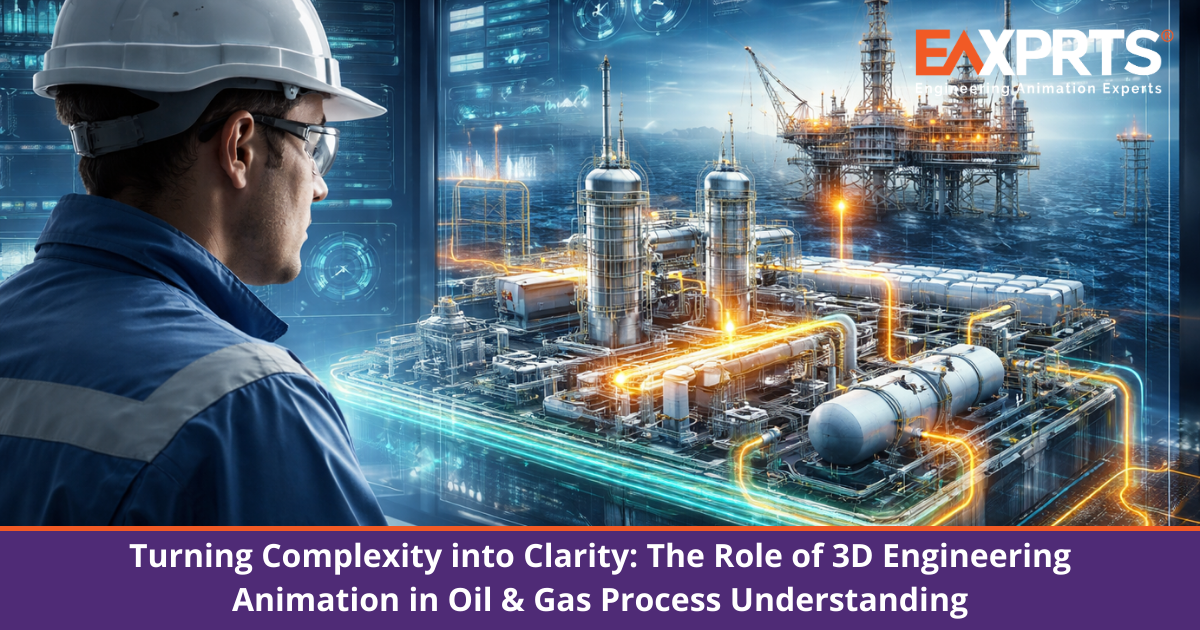
Turning Complexity Into Clarity: The Role of 3D Engineering Animation in Oil & Gas Process Understanding
Oil & Gas operations are among the most complex engineering environments in the world. From high-pressure separators and heat-intensive distillation units to thousands of meters of pipelines and automated safety systems, every component is interdependent and tightly regulated. Yet, despite this complexity or rather because of it clarity is essential. Misinterpretation of process flow, misunderstanding of equipment behaviour, or incorrect operational steps can have severe consequences: safety hazards, downtime, compliance failures, and costly mistakes.
Traditional engineering documents like P&IDs, 2D drawings, SOPs, and manuals have long been the backbone of Oil & Gas communication. While essential, they rely on the assumption that every stakeholder can read and interpret them accurately. In reality, that rarely happens. Process engineers, mechanical teams, operators, HSE personnel, EPC contractors, OEM suppliers, leadership, and investors all engage with system information differently.
This is where 3D engineering animation becomes a transformative tool. By visualizing systems, processes, and behaviours with precision, it converts complexity into clarity, making it easier for technical and non-technical audiences to understand exactly how Oil & Gas systems work.
Why Oil & Gas Systems Are Hard to Explain and Harder to Understand
Oil & Gas facilities involve hundreds of interconnected systems where mechanical, process, electrical, automation, and safety components operate simultaneously. The challenges that make these systems difficult to interpret include:
- Multiphase Processes Are Invisible in Real Life
Fluid separation, gas compression, chemical absorption, heat exchange, catalyst behaviour, and pressure changes aren’t visible during actual operation. Operators often rely solely on gauges and indicators to “interpret” what’s happening inside.
- P&IDs and 2D Drawings Lack Context
Even skilled engineers sometimes misinterpret P&IDs because they show connections, not real-life behaviour. Without dynamic visuals, it’s difficult to understand system interactions, startup sequences, or failure scenarios.
- Multidisciplinary, Global Stakeholder Groups
A single project may involve:
- Process engineers
- Mechanical teams
- EPC contractors
- OEM vendors
- Operators
- HSE managers
- Government regulators
- Leadership teams
Each stakeholder has different levels of technical understanding. 3D animation acts as a universal language.
- High Stakes and High Risks
Errors in Oil & Gas environments can cause:
- Uncontrolled pressure release
- Fire and explosion
- Production loss
- Environmental damage
- Compliance violations
Clear understanding is not optional it is foundational to safe operation.
How 3D Engineering Animation Transforms Technical Clarity
3D engineering animation turns static information into dynamic, accurate, intuitive visuals. It becomes easier for stakeholders to see what is happening, not just read or assume.
- Revealing Invisible Internal Processes
One of animation’s greatest strengths is its ability to visualize what no human eye can see:
- Vapor rising and liquid flowing inside a distillation tower.
- Gas-liquid separation in a three-phase separator.
- Pressure buildup and relief valve behaviour.
- Heat exchange inside coils and tubes.
- Chemical absorption and regeneration cycles in gas sweetening.
Such visuals make process understanding faster and far more accurate.
- Converting P&ID Logic into an Easy-to-Follow Story
A P&ID shows where things connect not how they behave.
Animation can:
- Show actual flow paths.
- Highlight control logic and interlocks.
- Illustrate valve operations in the correct sequence.
- Display alarms, shutdowns, and bypass routes.
- Visualize what happens if a component fails or a line overpressurizes.
Engineers often use animations during design reviews and HAZOPs because they help teams align quickly.
- Clarifying Interactions Between Mechanical and Process Systems
Oil & Gas systems don’t operate in isolation. Animation shows:
- How compressors influence downstream processing.
- How heat exchangers impact separator efficiency.
- How flare systems handle pressure deviations.
- How instrumentation responds to changes in temperature or flow.
Understanding these interactions is essential for troubleshooting and safety.
- Step-by-Step Visualization of Critical Operational Sequences
Startup, shutdown, and emergency operations are some of the hardest procedures to explain. With animation:
- SOPs become visual stories.
- Operators can see the consequences of incorrect sequencing.
- Safety interlocks are displayed with cause-and-effect clarity.
- Energy and flow transitions are shown dynamically.
This results in faster training and dramatically fewer interpretation errors.
- Scenario-Based Understanding for High-Risk Environments
3D animation makes it possible to illustrate scenarios that cannot be safely demonstrated in real life:
- Pressure surge in a pipeline
- Flash fire in a compressor house
- Gas leak and dispersion pattern
- Overpressure triggering the flare system
- Emergency shutdown activation
The result: better decision-making and improved hazard awareness.
Real Examples of Animation Simplifying Oil & Gas Complexity
- Distillation Column: Understanding Internal Dynamics
Animation shows:
- Temperature gradients
- Vapor flow upward
- Liquid reflux downward
- Tray interaction
- Purity control logic
This eliminates ambiguity around where separation occurs and why.
- Gas Compression System: Pressure, Energy, and Safety Logic
Animation clarifies:
- Suction → compression → discharge cycles
- Heat management
- Knock-out drum behaviour
- PSV and interlock operation
Operators and maintenance teams better understand compressor behaviour.
- Flare Systems: When and Why Flaring Happens
Animations effectively show:
- Pressure relief events
- Gas routing to the KO drum
- Flare stack combustion
- Pilot flame logic
- Environmental and safety roles
This is particularly useful for ESG reporting and stakeholder communication.
- LNG Process: Making Complex Thermodynamics Understandable
Animations simplify:
- Liquefaction stages
- Cryogenic heat exchange
- Vapor return systems
- Regasification flow paths
Without animation, LNG processes are extremely difficult to visualize.
How 3D Engineering Animation Improves Decision-Making Across the Oil & Gas Value Chain
- Faster Design and Engineering Reviews
Engineers reviewing a new system can instantly understand:
- Flow patterns
- Mechanical stress points
- Operational risk zones
- Interlock dependencies
This reduces the number of iterations and review cycles.
- Better Communication Between Teams and Vendors
Animation creates a shared understanding for:
- Procurement teams reviewing vendor skids
- OEMs explaining product functionality
- EPCs coordinating installation
- Regulators evaluating safety systems
It bridges technical knowledge gaps instantly.
- Enhanced Safety Awareness
Visual hazard communication drives better memory retention. Operators understand:
- What can go wrong
- How quickly it escalates
- What actions prevent escalation
This contributes to fewer errors and safer workplace.
- More Engaging and Accurate Training
Compared to text-heavy manuals:
- Animated SOPs reduce training time by up to 60%
- Operators understand the “Why” behind steps
- Complex tasks become easier to learn and repeat
- New hires adapt faster
Training is no longer passive, it becomes experiential.
- Stronger Stakeholder Alignment
Animation supports high-level decision-making by giving executives:
- Clear visual insights during project approvals
- Better understanding of system ROI
- Confidence in engineering preparedness
- Faster agreement across cross-country teams
This is powerful during board meetings, tender submissions, and international discussions.
Conclusion
In an industry where complexity is unavoidable and risk is ever-present, 3D engineering animation offers a decisive advantage. It transforms intricate Oil & Gas systems into intuitive, accurate, easily understandable visual narratives. Engineers design better, operators train smarter, HSE teams communicate hazards more effectively, and leadership makes more informed decisions.
“Clarity isn’t just a nice-to-have, it is a strategic necessity for modern Oil & Gas enterprises.”
3D engineering animation delivers that clarity with unmatched precision.
Talk to us today! Reach us on sales@eaxprts.com