From Engineering to Training: Where 3D Animation Delivers Maximum Impact in Oil & Gas
January 7, 2026
Visualizing Energy & Green Tech Systems with 3D Engineering Animation: A Strategic Guide from Concept to Operations
February 2, 2026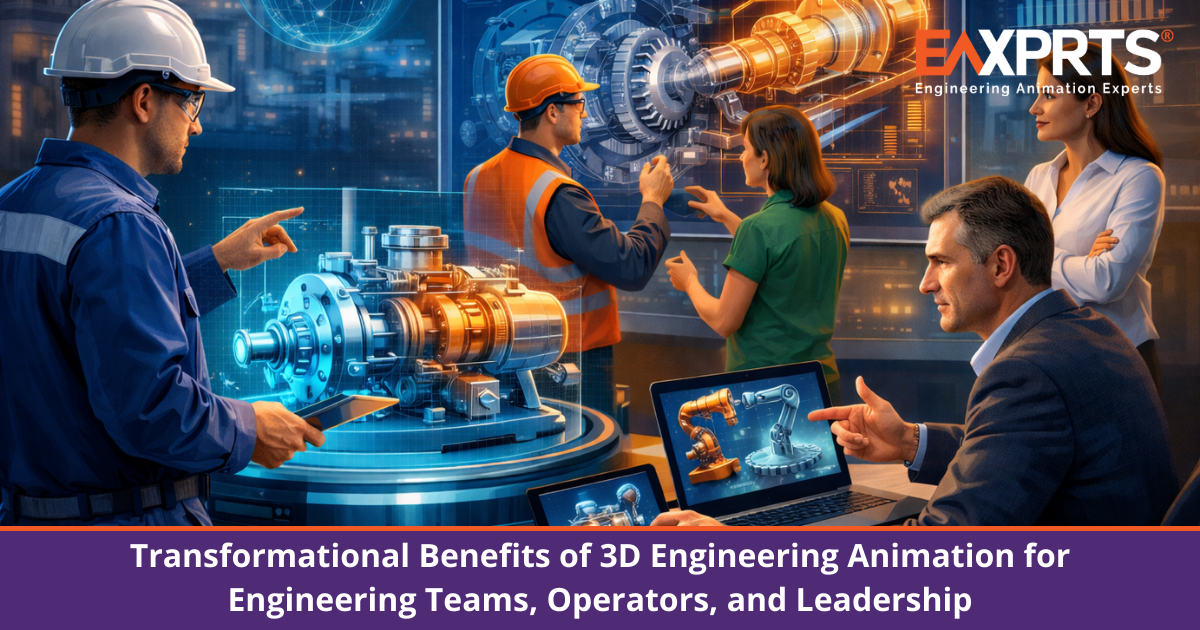
Transformational Benefits of 3D Engineering Animation for Engineering Teams, Operators, and Leadership
Oil & Gas operations are defined by technical depth, operational risk, and complex system interactions. Whether it’s a refinery distillation column, an offshore compression module, an LNG regasification terminal, or a gas sweetening unit, each system depends on precise workflows that must be understood and executed correctly.
Yet despite detailed documentation, engineering drawings, manuals, and training sessions, misunderstandings still occur. The reason is simple: text and static diagrams cannot fully explain dynamic processes, internal mechanisms, or real-time interactions inside Oil & Gas systems.
3D engineering animation bridges this communication gap. It transforms technical information into immersive, accurate visual stories that help engineering teams design better, operators work safer, and leadership make informed decisions. This is why global Oil & Gas companies are increasingly integrating 3D animation across design, operations, HSE, maintenance, and corporate communication.
This blog explores the transformational benefits that 3D engineering animation delivers to the key stakeholder groups that drive Oil & Gas operations.
Benefits for Engineering Teams
Engineering teams process, mechanical, electrical, instrumentation, and control, depend heavily on clarity and alignment. Even small misinterpretations can lead to design errors, safety gaps, or costly rework.
3D engineering animation enhances engineering workflows in the following ways:
- Faster Understanding of Complex Systems
Engineering drawings (P&IDs, GA drawings, equipment datasheets) are essential but not intuitive. 3D animation makes it easier to understand:
- The flow of gas, vapor, and liquid across a process
- Temperature and pressure transitions
- How mechanical and process systems work together
- Interaction between downstream and upstream units
Engineering teams can see exactly how a unit should function, making communication faster and more aligned.
- Early Identification of Design Issues
Animation supports engineering studies by making it easier to spot:
- Incorrect flow directions
- Improper equipment spacing
- Valve misplacement or logical gaps
- Under designed or overdesigned interlocks
- Mechanical clearances and access issues
- Wrong sequence logic during startup/shutdown
During HAZOP, SIL, or design reviews, these visuals help teams detect issues early, reducing project risk and cost.
- Improved Collaboration Across Disciplines
Oil & Gas teams rarely work in silos. Process engineers might define operating logic, mechanical teams specify equipment, automation teams configure the PLC/SCADA, and instrumentation teams handle sensors and transmitters.
Animation acts as a unifying visual language:
- Everyone sees the same process.
- Misinterpretations drop significantly.
- Review cycles become shorter and more efficient.
- Vendors and EPCs gain clearer expectations.
This results in improved project coordination and faster engineering alignment.
- Stronger Vendor and EPC Coordination
Vendors can use animations to showcase how their equipment interacts with plant utilities, safety devices, and control systems. EPC teams can visualize construction sequences, piping routes, and installation steps more accurately.
This reduces misunderstanding during technical bid evaluations, FAT, SAT, and site installation.
Benefits for Operators and O&M Teams
Operations and maintenance teams are responsible for ensuring that Oil & Gas facilities run safely, efficiently, and consistently. Their daily responsibilities require deep familiarity with equipment internals, process interactions, safety interlocks, and troubleshooting logic.
3D animation significantly enhances operator competency and readiness.
- Better Process Understanding
Operators learn faster when they can see what is happening inside equipment:
- Liquid levels inside a separator
- Vapor movement in a distillation tower
- Pressure buildup inside a pipeline
- TEG circulation inside a dehydration unit
- Anti-surge behaviour inside a compressor
This level of understanding dramatically improves decision-making in real operating conditions.
- More Effective Troubleshooting
Troubleshooting often depends on understanding hidden interactions:
- Why is discharge pressure unstable?
- Why did the pump cavitate?
- Why did the flare system activate?
- Why is the separator losing efficiency?
Animation explains causes visually rather than relying on text descriptions leading to:
- Faster diagnosis
- Fewer operational mistakes
- Better predictive maintenance
- Clearer SOPs for Startup, Shutdown, and Transitions
Critical operations such as:
- Cold startup
- Hot shutdown
- Emergency shutdown (ESD)
- Manual-to-auto transition
- Load ramping
- System isolation
can be animated step-by-step.
This ensures consistent training and fewer procedural errors, especially useful for rotating operators or new hires.
- Multi-Lingual and Cross-Cultural Training
Oil & Gas plants across the world involve multilingual workforces. Written SOPs often lose clarity when translated.
Animation eliminates this challenge because visuals speak universally.
- Reduced Training Time and Higher Retention
Research shows that visual learning improves retention by more than 50–70%.
Operators trained with 3D animation:
- Remember sequences longer
- Understand root causes better
- Follow instructions more precisely
- Avoid risky assumptions
This supports safer, more confident operations.
Benefits for HSE and Compliance Teams
Oil & Gas is one of the highest-risk industries. Safety teams must ensure that every worker understands operational hazards, emergency responses, and the correct behaviour in critical scenarios.
3D animation transforms safety communication in several ways.
- Visualizing Hazard Scenarios That Cannot Be Demonstrated Physically
Animation can illustrate scenarios such as:
- Gas leak and ignition
- Flash fire in a compressor house
- Overpressure leading to PSV release
- Tank overfill and internal vapor expansion
- Separator surge conditions
- Pipeline rupture and emergency isolation
These visuals create powerful awareness without exposing workers to actual danger.
- Strengthening LOTO, Confined Space, and HSE Training
Showing the why behind safety procedures increases compliance.
Examples animated effectively include:
- Lockout-Tagout
- Purging and inserting
- Permit-to-work steps
- Scaffolding and work-at-height hazards
- Chemical exposure risks
- Emergency response sequences
This prevents accidents and improves audit readiness.
- Supporting Regulatory and Client Compliance
3D animation is often used during:
- Safety case presentations
- Government approval submissions
- Insurance evaluations
- Environmental reporting
Clear visuals demonstrate preparedness and strengthen business credibility.
Benefits for Leadership and Management
Executives overseeing Oil & Gas projects must understand complex systems quickly—often without having engineering backgrounds.
3D animation becomes a strategic communication asset for them.
- High-Impact Visual Decision Support
Leaders can instantly understand:
- Project feasibility
- System design logic
- Safety risks
- CAPEX requirements
- Technology differentiation
This accelerates decision-making and reduces costly delays.
- Better Stakeholder Engagement
3D animation enhances communication during:
- Board presentations
- Joint venture discussions
- Client meetings
- Investment pitches
- Tender submissions
- Government reviews
Clear visuals build trust and strengthen the company’s technical credibility.
- Improved Alignment Across Global Teams
Large Oil & Gas corporations operate across continents. Animation ensures that:
- Teams in India, the Middle East, the Americas, and Europe understand the same information.
- Silos are reduced.
- Collaboration is smoother.
This results in more synchronized global operations.
Benefits for OEMs, Vendors, and Sales Teams
Technical products require technical explanations. Animation helps OEMs stand out in a competitive market.
- Clear Demonstration of Product Advantages
Animation visualizes internal mechanisms of:
- Pumps
- Valves
- Compressors
- Filters
- Seals
- Analyzer systems
- Control panels
This makes it easier for clients to understand product value instantly.
- Stronger Tender and Pre-Sales Support
During tender bids:
- Animation communicates technical superiority
- Complex features become easy to understand
- Customers feel more confident in the product
This increases win rates.
- Enhanced Digital Marketing and Trade Show Presence
Animations help companies attract decision-makers with:
- High-impact booth visuals
- Product explainers for websites
- LinkedIn and digital campaigns
- Customer presentations
OEMs become more memorable, persuasive, and trusted.
Quantifiable Impact: How 3D Animation Changes Outcomes
Companies adopting 3D engineering animation experience tangible gains:
- 30–60% faster training time
- Fewer operator errors
- Higher safety compliance scores
- Reduced engineering rework costs
- Shorter design review cycles
- Improved stakeholder communication
- Faster project approval and sign-off
These are not abstract benefits; they directly influence bottom-line performance and operational safety.
Conclusion
3D engineering animation is transforming how Oil & Gas teams learn, collaborate, operate, and lead. By turning invisible processes into clear visual narratives, it gives every stakeholder from engineers to executives the clarity required to make better decisions and operate more safely.
- Engineering teams design with greater accuracy.
- Operators work with deeper understanding.
- HSE teams communicate risk more effectively.
- Leadership gains confidence in complex projects.
- OEMs showcase innovation more persuasively.
In a technical, asset-heavy, high-risk industry, clarity isn’t optional, it’s a strategic advantage.
3D engineering animation delivers that clarity in a powerful, intuitive, and universally understandable format.
Talk to us today! Reach us on sales@eaxprts.com