

“Explainer Video” to Digital Twin: The New Value of 3D Engineering Assets
February 17, 2026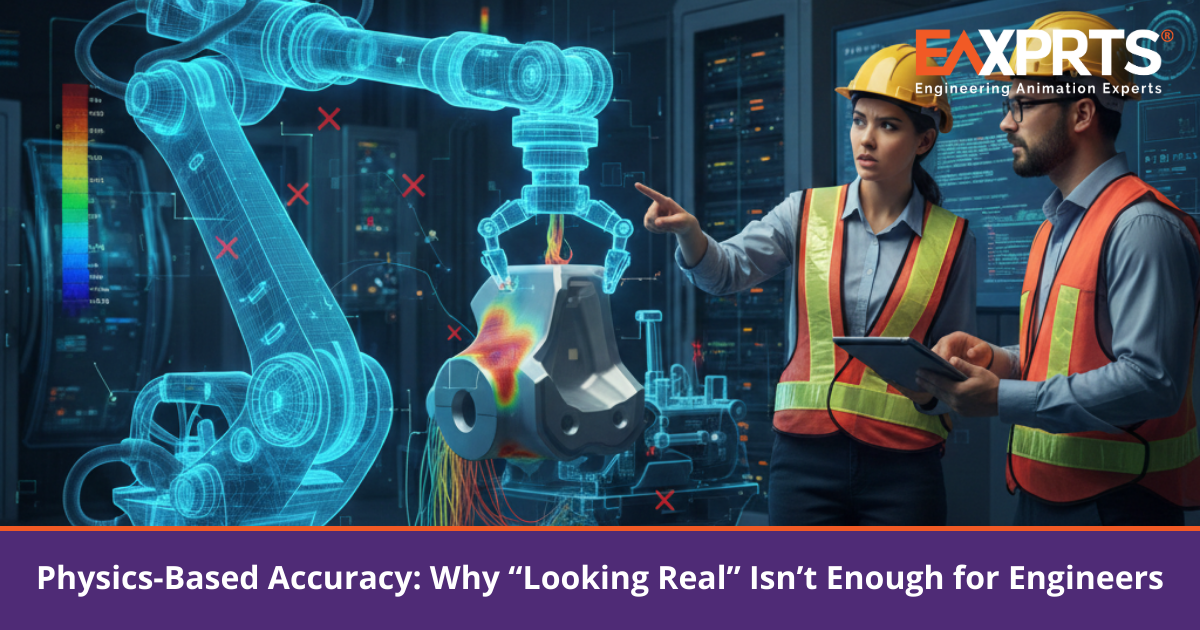
Physics-Based Accuracy: Why “Looking Real” Isn’t Enough for Engineers
Engineering professionals are trained to notice what others overlook.
They see load paths, tolerances, interference risks, thermal expansion, flow direction, and mechanical limits instinctively. So, when an animation shows a robotic arm accelerating beyond physical constraints, a fluid flowing against gravity, or two metal parts passing through each other without collision resistance, something breaks, not just visually, but intellectually.
The moment physics is violated credibility is lost.
Traditional engineering animations were built primarily for marketing clarity. Their goal was to simplify complexity and communicate concepts quickly. That approach worked when the audience was non-technical. But today, more engineering content is reviewed by plant managers, OEM engineers, operations directors, and safety teams. For them, visual appeal is secondary to technical authenticity.
This is where physics-based workflows become essential.
Platforms like NVIDIA Omniverse, powered by simulation engines such as NVIDIA PhysX, enable 3D assets to obey real-world constraints instead of artistic assumptions. The difference is not cosmetic, it is foundational.
The Credibility Gap in Traditional Engineering Animation
In conventional animation pipelines, motion is typically created using keyframes. An animator defines a start position, an end position, and a timing curve. The software interpolates between them. This approach is efficient and visually smooth, but it does not inherently respect physical laws.
Common physics violations include:
- Components intersecting without resistance
- Mechanisms exceeding mechanical speed limits
- Incorrect center-of-gravity behavior
- Unrealistic collision responses
- Fluid simulations that prioritize aesthetics over realism
While these shortcuts may go unnoticed in consumer advertising, they immediately undermine trust in technical industries.
When engineers detect inaccuracies, they begin to question everything else in the visualization, even elements that are correct.
Animation vs Simulation: A Fundamental Difference
To understand the shift toward physics accuracy, it is critical to distinguish between animation and simulation.
Animation
- Artist-driven motion
- Predefined paths and timing
- Focus on visual clarity
- No intrinsic physical validation
Simulation
- Physics-driven motion
- Constraint-based behavior
- Collision detection and response
- Real-world force modeling
In animation, objects move because someone tells them to. In simulation, objects move because physics allows them to.
For engineering audiences, that difference matters.
Why Engineering Teams Demand Behavioral Accuracy
Modern industrial systems are increasingly complex. Consider:
- High-pressure hydraulic systems
- Robotic assembly cells
- Thermal processes
- Heavy rotating equipment
- Material handling and flow systems
In these environments, small misrepresentations can distort understanding of risk, clearance, timing, and interaction.
For example:
- A conveyor system animated without realistic mass dynamics may misrepresent stopping distances.
- A pressure vessel shown failing without correct stress behavior may oversimplify safety risks.
- A robotic arm depicted without collision detection may conceal interference hazards.
Physics-based simulation ensures that what is shown aligns with mechanical and operational reality.
Physics Workflows Inside Omniverse
Omniverse integrates real-time physics simulation capabilities that go beyond visual rendering.
Through engines like PhysX, assets can be configured to:
- Respect rigid body dynamics
- Simulate mass and inertia
- Enforce joint constraints
- Detect and respond to collisions
- Model friction and damping
This enables engineering visualization teams to build assets that behave consistently under defined physical parameters.
Instead of manually animating a gear rotation, constraints can be defined so that motion propagates realistically through the assembly. Instead of keyframing a falling object, gravity and mass determine its trajectory.
This shift transforms the asset from a visual representation into a behaviorally accurate model.
Rigid Body Simulation: Getting Mechanics Right
Rigid body simulation is fundamental in mechanical systems.
When properly configured:
- Components cannot intersect unrealistically
- Motion stops at physical constraints
- Contact forces influence behavior
- Assembly interactions reflect real-world relationships
For industries such as heavy machinery, automotive, energy, and manufacturing, this level of accuracy builds confidence among technical reviewers.
It also enables early detection of issues such as interference, unrealistic motion ranges, or misaligned components, before physical prototypes are involved.
Particle and Fluid Simulation in Industrial Contexts
Fluid and particle behavior are especially sensitive areas in engineering visualization.
In traditional animation workflows, fluid motion is often stylized optimized for visual appeal rather than physical realism. However, in industries involving:
- Chemical processing
- Oil and gas
- Thermal systems
- Water treatment
- Pharmaceutical production
accurate flow representation matters.
Physics-driven particle and fluid simulations:
- Respect gravity and viscosity
- Reflect realistic flow dynamics
- Respond to pressure and obstruction
- Demonstrate turbulence and mixing behavior
This enhances both understanding and safety communication.
Safety and Risk Visualization: Showing Consequences Accurately
One of the most compelling applications of physics-based accuracy is safety training.
In safety-critical environments, it is not enough to show “what should happen.” Teams must understand what happens when things go wrong.
Physics-based simulation enables:
- Accurate collision detection
- Realistic equipment failure sequences
- Pressure release behavior
- Falling object dynamics
- Emergency stop response timing
By visualizing realistic consequences, organizations can improve training retention and operational awareness without exposing personnel to real-world risk.
The difference between a stylized failure animation and a physics-driven one is the difference between concept awareness and operational preparedness.
Building Trust with Technical Audiences
Trust is difficult to earn and easy to lose especially in engineering environments.
When animations reflect real-world constraints:
- Engineers engage rather than critique
- Operations teams use visuals for decision-making
- Safety departments reference simulations in training
- Leadership gains confidence in communication materials
Physics accuracy becomes a silent differentiator. Viewers may not consciously analyse the physics, but they recognize when behavior feels correct.
This trust has tangible business value:
- Faster approvals
- Reduced revision cycles
- Greater cross-functional adoption
- Stronger brand credibility
Beyond Marketing: Enabling Virtual Commissioning
Physics-based models also support advanced use cases such as virtual commissioning.
By simulating mechanical behavior and interactions in a digital environment:
- Processes can be validated before installation
- Motion sequences can be optimized
- Interference risks can be identified
- Control logic can be tested in context
This reduces downtime, accelerates deployment, and minimizes costly errors during physical commissioning.
Such capabilities move engineering visualization from presentation support into operational strategy.
Preparing for Digital Twin Integration
As discussed in the broader pillar, digital twins depend on accurate structural and behavioral foundations.
A visually impressive but physically inaccurate model cannot serve as the backbone of a digital twin.
Physics-ready assets provide:
- Defined constraints
- Logical hierarchies
- Behavioral parameters
- Clear interaction rules
When real-time operational data is later layered onto these assets, the digital twin behaves consistently with physical reality.
Skipping physics accuracy at the visualization stage often leads to costly retrofitting later.
The Competitive Advantage of Engineering-Grade Accuracy
In highly technical industries, differentiation rarely comes from aesthetics alone. It comes from precision, reliability, and depth.
Organizations that invest in physics-based engineering visualization gain:
- Higher credibility in technical sales discussions
- Stronger alignment between engineering and marketing
- Improved training effectiveness
- A scalable foundation for simulation and digital twins
In contrast, companies relying on purely aesthetic animation risk being perceived as surface-level.
As engineering decision-makers increasingly scrutinize technical communication, physics accuracy becomes a competitive advantage.
The Cultural Shift: From “Looks Good” to “Behaves Correctly”
Perhaps the most significant change required is cultural.
Visualization teams must move from asking:
“Does it look realistic?”
to asking:
“Does it behave realistically?”
This shift encourages collaboration between engineers and visualization specialists. It elevates the standard of technical communication. And it aligns digital representation with physical reality.
Conclusion
Engineering is built on precision.
When visualization aligns with physics, it reinforces that precision. When it violates physics, it undermines it.
Physics-based workflows powered by Omniverse and PhysX are not about adding visual complexity they are about restoring technical integrity to digital representation.
For organizations serious about digital twins, advanced training, virtual commissioning, and engineering credibility, “looking real” is no longer enough.
The future belongs to models that behave like reality, not just resemble it.
Talk to us today! Reach us on sales@eaxprts.com