

Visualizing Rebar Placement and Concrete Pouring Sequences with 3D Engineering Animations
December 29, 2025
The Complete Guide to WebXR for Industrial Facility Construction
December 29, 2025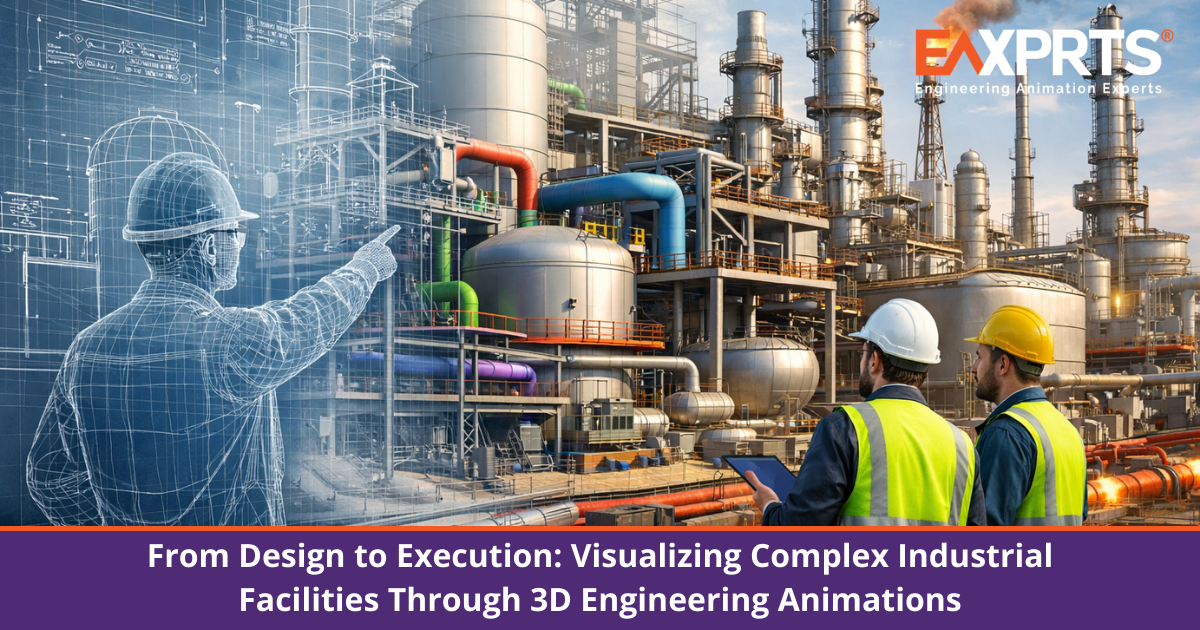
From Design to Execution: Visualizing Complex Industrial Facilities Through 3D Engineering Animations
Industrial construction projects are some of the most demanding undertakings in the world. Refineries, chemical plants, steel mills, automated manufacturing lines, utility facilities, and large-scale EPC installations involve thousands of engineering drawings, multi-disciplinary coordination, and strict safety requirements.
Despite advanced tools like BIM, CAD, and digital twins, many teams still struggle to visualize how designs translate into physical execution. Communication gaps between design, planning, and site execution often lead to rework, delays, and safety risks.
This is where 3D engineering animations transform the game, converting technical data into clear, visual stories that guide teams from concept to commissioning.
Before diving deeper, if you want to understand the broader transformation of construction workflows through animation, explore our blog article:
“How to Transform Construction Communication and Training with 3D Engineering Animations”
Why Industrial Facility Construction Needs Better Visualization
Industrial facilities are not like typical commercial or residential projects. They are large, multi-layered, and process-driven ecosystems where even a minor miscommunication can disrupt downstream operations.
Some challenges include:
Multi-Layered Data Overload
Engineers deal with:
- P&IDs
- General Arrangements (GA)
- Structural drawings
- Isometrics
- Process flow diagrams
- Equipment schedules
Each document explains only part of the system. Rarely does the workforce get a unified, visual understanding of how everything integrates.
Safety & Accessibility Concerns
Industrial sites are filled with:
- Confined spaces
- High-temperature zones
- Hazardous chemicals
- Heavy-lifting equipment
- Moving machinery
Text-based training simply cannot communicate these risks effectively.
Limitations in Stakeholder Communication
Clients, vendors, and regulators often struggle to visualize the facility layout or installation workflow through 2D drawings, leading to slow approvals.
This complexity demands a visual medium, one that shows “exactly how things will look and work” before construction begins.
What 3D Engineering Animation Brings to Industrial Facility Construction
3D engineering animations convert engineering intent into dynamic, accurate, and intuitive visual sequences. They replicate plant layout, construction progress, installation steps, and operational workflows exactly as they would occur on-site.
Key capabilities include:
- Complete 3D representation of industrial equipment
- Construction and installation sequencing
- Walkthroughs of plant layouts
- Visualization of process flows
- Safety behavior demonstrations
- Commissioning and startup workflows
Animations make complex facilities easier to understand for engineers, contractors, clients, workers, and stakeholders regardless of technical background.
Visualizing Pre-Construction: From Concept to Site Readiness
The planning phase is where 3D animation dramatically enhances decision-making.
Master Layout Visualization
Animations can recreate the full industrial facility, including:
- Equipment bays
- Utility corridors
- Piping and cable routing
- Access pathways
- Safety zones
- Storage yards
- Operational and maintenance areas
Teams can visually evaluate spacing, clearances, access constraints, and safety routes long before breaking ground.
Early Hazard Identification
With a 3D animated walkthrough, teams can spot:
- Crane access conflicts
- Vehicle movement bottlenecks
- Hot-zone overlaps
- Emergency exit limitations
- Obstructions in maintenance access
These issues can then be fixed during design, not on-site — saving time and cost.
Design Validation & Faster Approvals
Stakeholders understand designs faster with visuals rather than drawings. This improves:
- Design review cycles
- Technical presentations
- Vendor alignment
- Regulatory approvals
It eliminates ambiguity before construction begins.
Visualizing Construction & Installation Sequences (The Heart of Execution)
Industrial projects involve thousands of construction activities — many of them interdependent. 3D animation is especially powerful in demonstrating time-based construction sequencing.
Civil Works
Animations can show step-by-step sequences such as:
- Land preparation
- Excavation
- Foundation marking
- Rebar placement (link to your rebar cluster blog)
- Concrete pouring
- Curing and formwork removal
- Structural steel erection
Visual storytelling ensures teams understand the exact sequence, reducing errors and rework.
Mechanical Installation
Most industrial projects require heavy and precise mechanical installations:
- Pressure vessels
- Boilers
- Reactors
- Pumps, compressors, fans
- Conveyors and material handling systems
Animations demonstrate:
- Lifting strategies
- Rigging points
- Equipment alignment
- Grouting procedures
This helps field teams prepare accurately.
Piping & Ducting Systems
Piping networks in industrial plants are extremely dense. 3D animations visualize:
- Spool installation
- Fit-up sequences
- Weld paths
- Hydro-test procedures
- Insulation and cladding steps
Teams can see how pipes route through structures and avoid clashes.
Electrical & Instrumentation Works
Animations are useful for:
- Junction box locations
- Cable pulling workflows
- Instrument installation
- Panel integration
- Loop check processes
This reduces confusion during late-stage installation.
Visualizing Industrial Processes (Beyond Physical Construction)
Industrial facilities are deeply process-driven. Animations can illustrate the actual operating behavior of equipment and systems.
Process Flow Simulation
Animations can show how materials move through:
- Mixers
- Furnaces
- Crushers
- Pumps
- Reaction chambers
- Heat exchangers
- Conveyors
- Filtration systems
Teams gain a deeper understanding of the process before start-up.
Utility System Visualization
Most industrial plants rely on support systems like:
- Cooling water
- Steam
- Compressed air
- HVAC
- Fire hydrant systems
- Nitrogen & inert gas lines
Animations demonstrate their interactions, pressure zones, and distribution paths.
Hazardous Operations
3D animation can visually explain:
- High-pressure operations
- Explosion risk (Area Classification)
- Toxic or flammable material handling
- Purging and inerting
- Emergency shutdown procedures
This is nearly impossible to explain effectively using static documents.
Safety Visualization Through 3D Animation
Safety is where animation brings maximum value. Work-at-Height Modules.
Animations demonstrate:
- Scaffold installation
- Platform safety
- Harness anchoring
- Ladder use
Workers understand safe methods visually, not theoretically.
Confined Space Entry Training
Animations can explain:
- Safe access points
- Ventilation requirements
- Gas testing
- Rescue paths
- PPE requirements
Emergency Response & Evacuation
Animations illustrate:
- Muster points
- Evacuation routes
- Fire suppression activation
- Shutdown sequences
This improves site readiness and emergency preparedness.
Crane & Lifting Safety
Visualizing load paths and exclusion zones reduces lifting accidents.
Commissioning & Start-Up: Visualizing the Final Critical Stage
Commissioning is one of the most misunderstood phases in industrial facility construction. Animation simplifies it.
Pre-Commissioning
- Cleaning and flushing
- Pressure testing
- Alternating wet/dry run
- System energization
System-Level Commissioning
- Loop checks
- PLC logic testing
- Calibration
- Field instrument configuration
Start-Up Sequences
Animations show:
- Step-by-step system activation
- Control panel behavior
- Safety interlock demonstration
- Operating parameters
This leads to fewer startup errors and faster stabilization.
Improved Client, Vendor & Regulatory Communication
Vendor Alignment
Animations clarify:
- Equipment installation constraints
- Delivery and staging areas
- Assembly sequencing
This minimizes misunderstandings with OEMs.
Client Presentations
Clients can see exactly how the facility will function — not guess from drawings. This builds trust and transparency.
Regulatory Approvals
Safety animations help explain compliance measures for:
- Fire safety
- Environmental controls
- Hazardous area classification
- Occupational safety
They accelerate audit cycles.
Integration with Modern Digital Tool (WebXR)
Teams can experience the facility in:
- Virtual walkthroughs
- Browser-based virtual experiences
- Remote training sessions
No special hardware required.
Business Impact: Turning Visualization into Measurable Value
Organizations implementing 3D animation of industrial facility typically achieve:
Cost Savings
- Less rework
- Faster approvals
- Optimized installation planning
Improved Safety
- Higher training retention
- Fewer incidents
- Better hazard awareness
Productivity Gains
- Reduced supervision dependency
- Smoother coordination
- Faster commissioning
Stakeholder Confidence
- Stronger bids for EPC tenders
- Clearer communication with clients
Conclusion
In complex industrial construction, success depends on clarity. Teams must understand what to build, how to build, how it works, and how to stay safe.
3D engineering animations deliver that clarity. They turn technical complexity into intuitive, accurate, and high-impact visual experiences that guide teams through every phase from conceptual design to final commissioning.
Visualizing the process before executing it is no longer optional.
It is the new standard for industrial construction excellence.
Talk to us today! Reach us on sales@eaxprts.com