Optimizing Energy Infrastructure Design, Installation, and Maintenance with 3D Engineering Animation
February 2, 2026
Breaking the Silos: How OpenUSD Is Unifying Engineering and Animation Workflows
February 17, 2026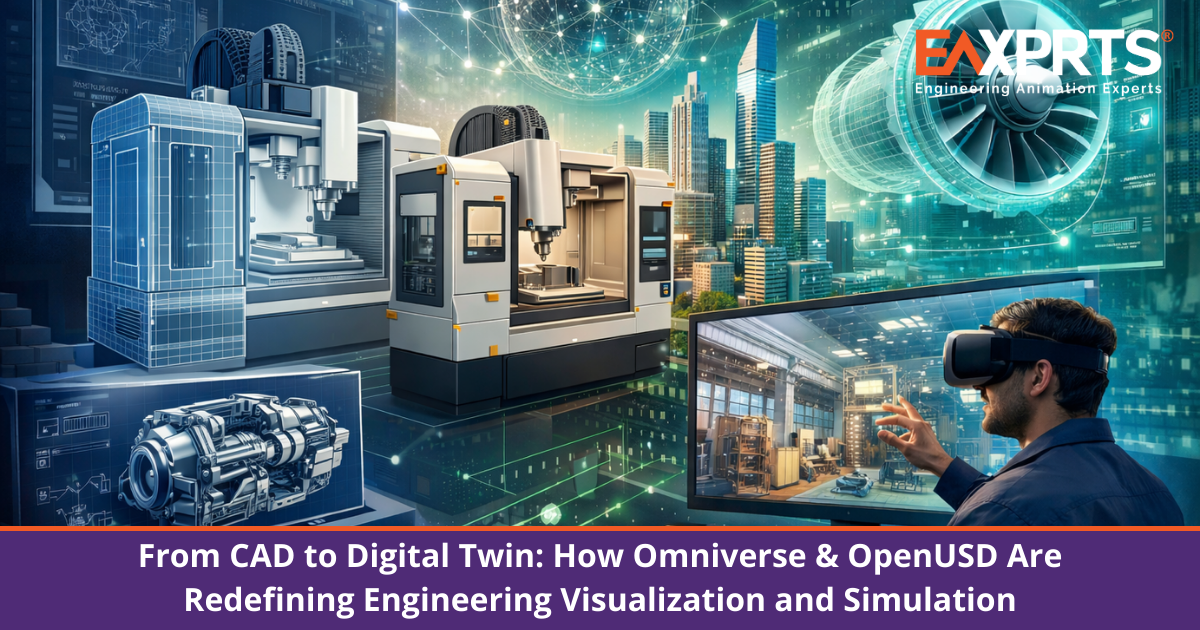
From CAD to Digital Twin: How Omniverse and OpenUSD Are Redefining Engineering Visualization
For decades, 3D visualization in engineering served a narrow purpose, explain a product, support a proposal, or enhance a trade-show presentation. Once the animation was rendered and delivered, the underlying 3D data was typically archived, never to be reused again.
At the same time, engineering teams were working in parallel with CAD, simulation, and manufacturing tools, often disconnected from the visualization pipeline entirely. What resulted was a familiar pattern: duplicated effort, repeated exports, geometry simplification, loss of design intent, and a growing gap between what was engineered and what was visualized.
Engineering Visualization Is No Longer Just About “Showing”
With the emergence of OpenUSD (Universal Scene Description) and real-time collaborative platforms like Omniverse, engineering visualization is evolving from a one-time deliverable into a persistent, reusable, simulation-ready digital asset that can support marketing, training, operations, and even future digital twin initiatives.
This shift is not cosmetic. It is structural.
The Core Problem: Fragmented CAD, Animation, and Simulation Pipelines
Traditional engineering animation workflows were never designed for accuracy at scale.
The moment CAD data left its native environment, it was treated as disposable geometry, exported, decimated, converted into meshes, and manually repaired to make it suitable for animation software. Each handoff introduced risk:
- Loss of parametric intelligence
- Broken topology and missing assemblies
- Manual interpretation of motion and constraints
- Rework every time the engineering design changed
For engineering teams, this created distrust. For visualization teams, it created inefficiency. For leadership, it resulted in longer revision cycles and higher costs with limited long-term value.
Most critically, once an animation was completed, the asset had no operational life beyond marketing.
OpenUSD: Establishing a Single Source of Truth for Engineering Visualization
OpenUSD fundamentally changes how engineering data is managed, shared, and visualized.
Instead of destructive file conversions, OpenUSD introduces a layered, non-destructive data model. The original engineering geometry can remain intact as a protected base layer, while visualization elements, materials, lighting, animation, annotations, and physics exist as separate, additive layers.
This approach enables a true single source of truth:
- Engineering data is preserved, not rewritten
- Visualization does not overwrite design intent
- Multiple teams can work simultaneously without conflict
- Changes propagate without manual rebuilding
For the first time, engineering accuracy and visual storytelling can coexist in the same environment without compromise.
Breaking the Export–Rebuild Cycle
In a traditional workflow, even a minor engineering change such as a valve repositions or bracket modification required:
- Re-exporting CAD
- Re-optimizing geometry
- Re-aligning animations
- Re-validating visual accuracy
With OpenUSD-based workflows, those changes can be reflected directly and live in the visualization scene. Engineering updates no longer invalidate animation work; they simply update the base layer while visualization layers remain intact.
The impact is immediate:
- Faster revision turnaround
- Fewer interpretation errors
- Reduced dependency on manual fixes
- Higher confidence in technical accuracy
Omniverse: Where Visualization Becomes Simulation-Ready
While OpenUSD provides the data backbone, Omniverse provides the environment where engineering visualization evolves into behaviourally accurate simulation.
In Omniverse, visualization is no longer limited to appearance. Assets can:
- Obey real-world physics
- Respect mechanical constraints
- Simulate motion, collision, and interaction
- Maintain scale, mass, and material properties
This distinction matters.
A model that merely looks correct may satisfy marketing. A model that behaves correctly earns trust from engineers, operators, and safety teams.
From Visual Representation to Behavioural Accuracy
Engineering audiences immediately recognize when an animation cheats physics when components move faster than mechanically possible, when fluids defy gravity, or when assemblies intersect unrealistically.
Omniverse introduces physics-based workflows where motion and interaction are driven by simulation, not artistic assumption. This creates a new class of engineering visualization:
- Mechanisms move within real limits
- Assemblies collide and respond correctly
- Particles, fluids, and forces behave realistically
The result is not just a better animation it is a credible technical representation of reality.
Lifecycle Value: Turning Animation into a Long-Term Digital Asset
The most transformative impact of Omniverse-based workflows is asset longevity.
A single, well-structured engineering 3D asset can now support multiple stages of the asset lifecycle:
- Marketing & Sales: high-fidelity product and process visualization
- Installation & Commissioning: step-by-step sequencing and clash validation
- Training & Safety: realistic operational scenarios and failure simulations
- Operations: layout planning, maintenance visualization, and process understanding
- Future Digital Twins: foundation for sensor integration and real-time monitoring
Instead of paying repeatedly for new content, organizations begin investing once in assets that evolve with their needs.
Digital Twin Readiness Starts Earlier Than Most Companies Think
A common misconception is that digital twins require full IoT integration from day one. In reality, the most difficult part of any digital twin initiative is building an accurate, structured, and behaviourally correct 3D foundation.
Omniverse-ready assets provide that foundation:
- Spatial accuracy
- Mechanical realism
- Clear data structure
- Extensibility for future intelligence
By starting with simulation-ready visualization, companies reduce the cost and complexity of future digital twin programs often by years.
What This Shift Means for Engineering & Industrial Organizations
For engineering-driven companies, the implications are significant:
- Visualization stops being a cost center and becomes a strategic asset
- Engineering and marketing stop working in isolation
- Revisions become faster, cheaper, and more accurate
- Digital transformation initiatives start with less friction
Most importantly, engineering leaders regain confidence that what is being shown externally truly represents what is being built internally.
What This Means for Engineering Animation Studios
This shift also redefines the role of technical visualization partners.
Studios that continue to deliver one-off videos will compete on price. Studios that build simulation-ready engineering assets become long-term partners supporting product launches, training programs, operational planning, and future digital twins from the same core dataset.
The value proposition moves from “content creation” to engineering visualization infrastructure.
Conclusion
Engineering visualization is no longer a final step. It is becoming a foundational layer in how products, plants, and processes are communicated, validated, and operated.
OpenUSD ensures accuracy and data continuity.
Omniverse enables realism, collaboration, and scalability.
Together, they redefine what 3D engineering visualization can and should deliver.
The question for engineering organizations is no longer whether this shift will happen, but how early they choose to adopt it.
If your organization is still treating 3D animation as a one-time deliverable, it may be time to rethink the role of visualization in your engineering and digital transformation strategy.
Talk to us today! Reach us on sales@eaxprts.com