From CAD to Digital Twin: How Omniverse and OpenUSD Are Redefining Engineering Visualization
February 17, 2026
“Explainer Video” to Digital Twin: The New Value of 3D Engineering Assets
February 17, 2026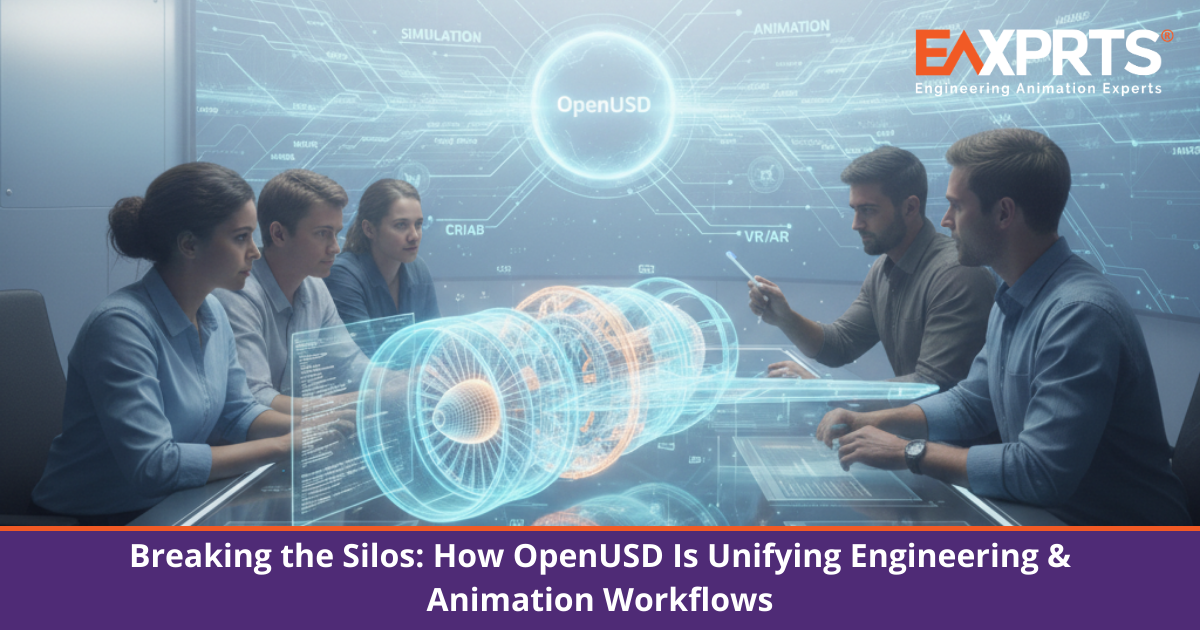
Breaking the Silos: How OpenUSD Is Unifying Engineering and Animation Workflows
In most industrial organizations, engineering and visualization teams have historically worked in parallel but rarely together. Mechanical engineers design products and systems in CAD environments optimized for precision, parametrics, and manufacturability. Visualization and animation teams, on the other hand, operate in creative tools optimized for storytelling, rendering, and presentation.
The moment engineering data crosses that boundary, friction begins.
Why Engineering Visualization Has Always Been a Handoff Problem
CAD models are exported, simplified, converted, and rebuilt to fit animation pipelines. Assemblies lose intelligence. Parametric relationships disappear. Design intent is reduced to static geometry. Every engineering revision, no matter how small, forces a partial or complete rebuild of the visualization asset.
This disconnect is not just inefficient. It is structural.
As engineering products become more complex and revision cycles accelerate, the traditional “export–animate–render” workflow collapses under its own weight. What organizations need is not a faster export but a shared data foundation that allows engineering and visualization to coexist without overwriting or compromising each other.
This is precisely the problem OpenUSD was designed to solve.
The Traditional CAD-to-Animation Bottleneck
For decades, the pipeline between engineering and animation has been fundamentally one-directional.
Once CAD data leaves its native environment, it is treated as disposable geometry. Parametric features, constraints, metadata, and assembly logic are stripped away to create polygonal meshes suitable for animation tools. This conversion introduces several persistent problems:
- Loss of design intelligence – parametric relationships and constraints vanish
- Geometry errors – missing faces, flipped normals, broken assemblies
- Manual interpretation – animators guess motion, tolerances, and sequences
- High revision cost – every design update forces rework
What makes this particularly damaging is that engineering revisions are inevitable. Valve positions change. Supports are added. Clearances are adjusted. When visualization pipelines are fragile, teams avoid updating animations, leading to outdated or technically incorrect visuals being reused far beyond their validity.
Over time, engineering teams lose trust in visualization, and visualization teams become disconnected from engineering reality.
Why Exports Fail as a Collaboration Model
At its core, the export-based workflow fails because it assumes a final state.
Exports assume the design is “done.”
Engineering reality assumes continuous change.
This mismatch creates organizational silos:
- Engineering owns CAD
- Visualization owns meshes
- No one owns continuity
The result is duplication of effort, slower iteration, and a growing gap between what is engineered and what is shown.
To solve this, the industry does not need better exporters. It needs a non-destructive, layered data model that allows multiple disciplines to work on the same asset, without overwriting each other.
OpenUSD: A Single Source of Truth for 3D Engineering Data
OpenUSD introduces a fundamentally different way of thinking about 3D data.
Instead of converting and replacing geometry, OpenUSD allows multiple representations of the same asset to coexist through layering and composition. The original engineering data can remain intact as a protected base layer, while visualization-specific elements are added on top, without modifying the source.
This enables a true single source of truth:
- Engineering geometry remains authoritative
- Visualization does not overwrite design intent
- Simulation, animation, and rendering layers coexist independently
- Changes propagate without destructive rework
In practical terms, this means engineering and animation stop fighting over ownership of the model. Each discipline contributes its own layer, without breaking the other.
Understanding Non-Destructive Layering
At the heart of OpenUSD is the concept of non-destructive layering.
Think of a 3D asset not as a single file, but as a stack of layers, each serving a specific purpose:
- Base layer: Engineering CAD geometry and assemblies
- Material layer: Visual materials, textures, and finishes
- Animation layer: Motion, sequencing, and timing
- Simulation layer: Physics, constraints, and interactions
- Annotation layer: Labels, callouts, and instructional overlays
Each layer can be updated, replaced, or disabled independently, without touching the others.
This architecture allows engineering teams to continue iterating on design while visualization teams build stable, reusable animation and presentation layers on top.
From File Ownership to Data Continuity
Traditional workflows treat files as ownership boundaries. OpenUSD treats data as a shared continuum.
This distinction is critical for organizations managing complex products or facilities. Instead of asking, “Which file is the latest?”, teams ask, “Which layer has changed?”
Versioning becomes clearer. Accountability improves. And most importantly, visualization assets remain valid even as engineering evolves.
Real-Time Collaboration in Practice
The true power of OpenUSD becomes evident when paired with collaborative platforms such as NVIDIA Omniverse.
In an Omniverse-connected workflow, engineering tools and visualization tools no longer operate in isolation. Changes made in engineering software such as SolidWorks, can be reflected directly in the shared USD scene.
Consider a real-world scenario:
- A mechanical engineer updates a valve orientation to improve service access
- The CAD layer updates in the shared OpenUSD scene
- The animation layer remains intact
- The visualization team sees the update instantly, no re-export required
What previously took days of back-and-forth can now happen in minutes.
Eliminating Rebuild Cycles
In traditional pipelines, a single engineering change can invalidate weeks of animation work. With OpenUSD-based workflows, changes propagate cleanly through the layer stack.
This eliminates:
- Re-importing geometry
- Re-aligning animations
- Re-validating assemblies
- Re-rendering outdated visuals
Instead, teams focus on refinement rather than reconstruction.
Why This Matters for Engineering-Driven Organizations
The benefits of unified workflows extend far beyond convenience.
Faster Iteration Without Compromising Accuracy
When visualization no longer depends on frozen geometry, organizations can iterate more aggressively, without fearing rework. This is particularly valuable in:
- EPC projects
- Complex machinery development
- Modular and configurable product lines
Guaranteed Geometric Fidelity
Because visualization layers sit on top of authoritative engineering data, there is no ambiguity about accuracy. What is shown is what is designed, down to tolerances and clearances.
Reduced Long-Term Visualization Costs
Reusable, layered assets dramatically reduce the cost of future updates. Marketing refreshes, training content, and technical documentation can all leverage the same core dataset.
Breaking Organizational Silos, Not Just Technical Ones
While OpenUSD is a technical standard, its real impact is organizational.
When engineering and visualization share a data foundation:
- Engineers gain confidence in visuals
- Visualization teams gain access to accurate data
- Decision-makers receive consistent information
- Knowledge silos begin to dissolve
This alignment is increasingly critical as organizations move toward digital twins, virtual commissioning, and AI-driven simulation.
OpenUSD as the Foundation for Future-Ready Pipelines
Perhaps the most important aspect of OpenUSD is that it is forward-compatible.
Assets built using OpenUSD today are not limited to animation use cases. They can later support:
- Physics-based simulation
- Training environments
- Virtual commissioning
- Digital twin platforms
- AI and robotics simulation
By adopting OpenUSD early, organizations avoid the costly “rebuild everything” phase that often derails digital transformation initiatives.
Conclusion
For decades, engineering and animation have been forced to compromise accuracy for speed, fidelity for convenience, or collaboration for control.
OpenUSD removes that trade-off.
By enabling non-destructive, layered workflows, it allows engineering and visualization to work together without overwriting each other. When paired with real-time collaborative platforms, it transforms visualization from a downstream activity into a shared engineering capability.
Breaking silos does not require new departments or heavier processes.
It requires a shared foundation.
OpenUSD provides that foundation.
Talk to us today! Reach us on sales@eaxprts.com
Recommendation Articles