Breaking the Silos: How OpenUSD Is Unifying Engineering and Animation Workflows
February 17, 2026
Physics-Based Accuracy: Why “Looking Real” Isn’t Enough for Engineers
February 17, 2026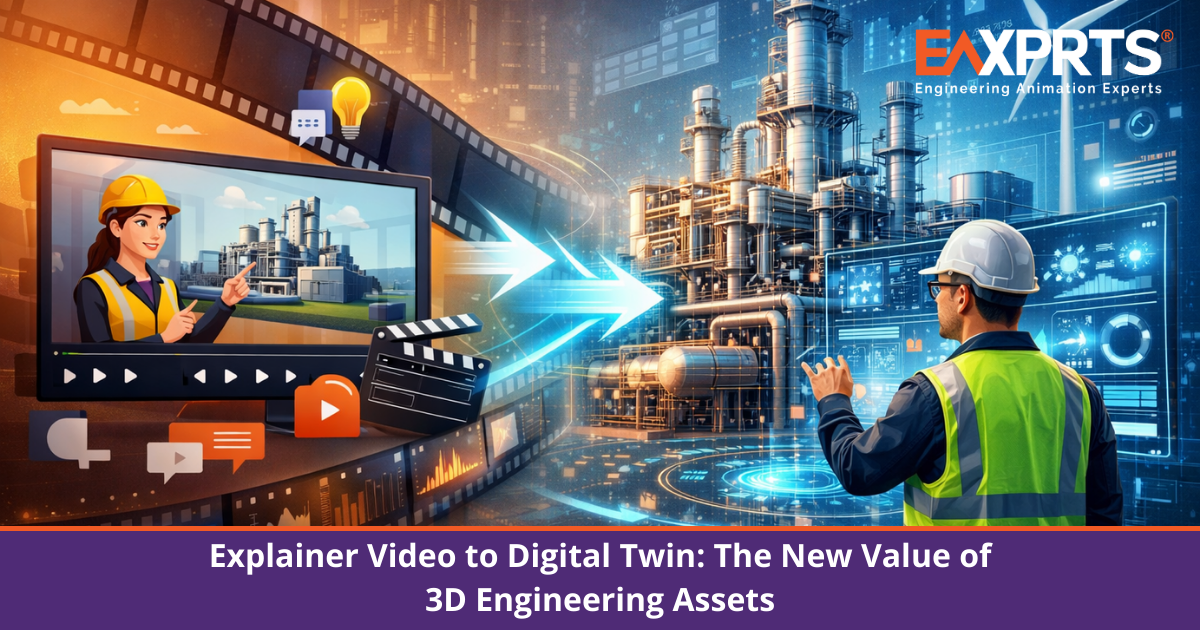
“Explainer Video” to Digital Twin: The New Value of 3D Engineering Assets
As industries move toward smart factories, connected equipment, and digital twins, accurate 3D representations are no longer optional artifacts, they are strategic assets. The question is no longer how good the animation looks, but how much long-term value the 3D data can deliver.
This is where platforms like NVIDIA Omniverse fundamentally change the equation.
In many engineering-led organizations, the lifecycle of a 3D asset is surprisingly short.
A detailed 3D animation is commissioned to support a product launch, a proposal, or a trade-show presentation. It is rendered, approved, delivered and then quietly archived. The underlying 3D data, often built with significant time and cost, is rarely reused. When the next requirement arises, training, installation guidance, or operational visualization, the process starts again from scratch.
This approach made sense when 3D visualization was primarily a communication tool.
It makes far less sense today.
The Traditional “Explainer Video” Model and Its Limits
Traditional engineering animations are designed with a single objective: visual clarity.
They explain how a system works, how a product is assembled, or how a process flows. Once rendered, their job is done. The asset is locked into a fixed narrative, with no structural connection to engineering logic, physical behaviour, or operational reality.
This creates three systemic limitations:
- No Reusability: The animation cannot be adapted for new use cases without significant rework.
- No Functional Accuracy: Motion, behaviour, and interactions are often artist-driven rather than physics-driven.
- No Lifecycle Continuity: The asset has no role beyond communication, it cannot support operations, training, or simulation.
As organizations invest more heavily in digital transformation, these limitations become increasingly costly.
Visual Assets vs Functional Engineering Assets
To understand the shift, it is important to distinguish between two fundamentally different types of 3D assets.
- Visual-Only Assets
Visual-only assets prioritize appearance:
- Optimized meshes
- Predefined camera paths
- Keyframed motion
- No real-world constraints
They are ideal for marketing, but fragile beyond that context.
- Functional Engineering Assets
Functional assets prioritize behaviour and structure:
- Correct scale, mass, and hierarchy
- Mechanical constraints and limits
- Physics-based interactions
- Clean data structure and metadata
These assets may still look impressive, but their real value lies in what they can become.
Omniverse enables the second category.
Why Omniverse Changes the Economics of 3D Assets
Omniverse is not just a rendering or collaboration platform. It is an environment designed to preserve engineering intent while enabling multiple downstream uses.
Assets built within Omniverse and structured using OpenUSD are not locked into a single output. They are modular, layered, and extensible.
This changes the cost model entirely:
- One core asset
- Multiple applications
- Long-term ROI
Instead of paying repeatedly for new 3D content, organizations invest once in a simulation-ready foundation.
Lifecycle Value: One Asset, Many Uses
The true power of Omniverse-based assets becomes clear when viewed across the asset lifecycle.
- Marketing and Sales Enablement
High-fidelity visualization remains a critical use case:
- Product explainers
- Proposal visuals
- Trade-show experiences
- Investor presentations
The difference is that these visuals are no longer throwaway outputs, they are derived from a persistent engineering asset.
- Training and Knowledge Transfer
Traditional training materials often rely on static diagrams.
With Omniverse-ready assets, training teams can:
- Visualize real equipment behaviour
- Demonstrate correct and incorrect operations
- Show cause-and-effect relationships
- Simulate failure scenarios safely
This improves comprehension, retention, and operational readiness, especially for complex machinery and processes.
- Installation, Commissioning, and Maintenance
For large equipment and facilities, installation errors are expensive.
Functional 3D assets can support:
- Installation sequencing
- Clearance and access validation
- Maintenance path visualization
- Retrofit and upgrade planning
Because the asset respects real geometry and constraints, it can be trusted as a planning tool not just a visual reference.
- Operations and Layout Planning
Even without live data integration, accurate 3D assets provide operational value:
- Space utilization analysis
- Process flow visualization
- Equipment interaction understanding
- Scenario planning
This bridges the gap between engineering documentation and real-world operations.
Digital Twin Readiness Starts with Structure, Not Sensors
One of the most common misconceptions around digital twins is that they begin with IoT.
In reality, most digital twin initiatives fail because they lack a clean, accurate, and structured 3D foundation. Sensors provide data, but without a reliable spatial and behavioural model, that data has little contextual meaning.
Omniverse-ready assets solve this foundational problem:
- Geometry is accurate
- Assemblies are logically structured
- Motion respects constraints
- Physics behaviour is defined
This allows organizations to layer intelligence later without rebuilding the model.
From Visualization to Simulation
Another critical distinction is between representation and simulation.
A visual model shows what something looks like. A simulation-ready model shows how it behaves.
In Omniverse, assets can evolve from passive visuals into active simulations:
- Rigid body interactions
- Mechanical motion limits
- Collision detection
- Particle and flow behaviour
This capability becomes especially important for:
- Safety analysis
- Process validation
- Virtual commissioning
- AI and robotics training
Supporting AI and Robotics Training
Beyond human training, Omniverse-based assets are increasingly used to train machines.
Simulation-ready environments can be leveraged for:
- Robotic motion planning
- Collision avoidance training
- Autonomous system testing
- Synthetic data generation
This expands the value of 3D assets far beyond their original scope often into domains not anticipated during initial visualization projects.
The Strategic Upsell: Simulation-Ready, Not Just Render-Ready
For engineering visualization partners, this shift changes the nature of client conversations.
Instead of selling “a video,” the discussion moves toward:
- Asset reusability
- Lifecycle value
- Future digital twin readiness
- Reduced long-term costs
Clients begin to see visualization as digital infrastructure, not content.
This reframing is critical for organizations aiming to scale digital initiatives without repeated reinvestment in foundational assets.
Reducing Future Digital Transformation Costs
Perhaps the most compelling business argument for Omniverse-based assets is cost avoidance.
Organizations that invest early in structured, simulation-ready 3D data:
- Avoid rebuilding models later
- Reduce onboarding friction for new tools
- Accelerate future digital twin programs
- Lower total cost of ownership
In many cases, the incremental cost of “doing it right” upfront is significantly lower than the cost of retrofitting assets later.
Organizational Impact: Aligning Teams Around Shared Assets
Reusable 3D assets also change how teams collaborate.
When marketing, training, operations, and engineering reference the same core model:
- Information stays consistent
- Updates propagate across departments
- Knowledge silos shrink
- Decision-making improves
This alignment becomes increasingly important as organizations scale globally and manage complex product portfolios.
Conclusion
The era of disposable engineering animations is ending.
As digital twins, simulation, and AI-driven operations become mainstream, the value of 3D assets lies in their longevity and adaptability, not just their visual appeal.
Platforms like Omniverse and standards like OpenUSD, enable organizations to rethink how they invest in visualization:
- From one-time outputs
- To persistent, evolving digital assets
The organizations that recognize this shift early will not just save costs they will build a stronger foundation for future innovation.
Talk to us today! Reach us on sales@eaxprts.com