

The Complete Guide to WebXR for Industrial Facility Construction
December 29, 2025
Turning Complexity Into Clarity: The Role of 3D Engineering Animation in Oil & Gas Process Understanding
January 7, 2026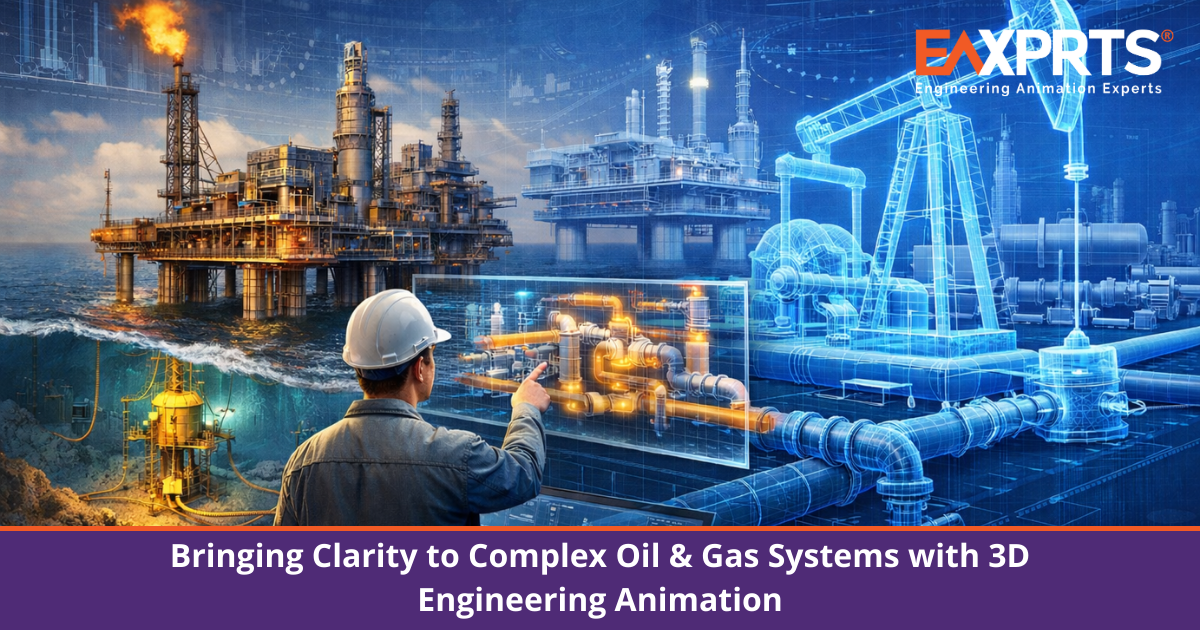
Bringing Clarity to Complex Oil & Gas Systems with 3D Engineering Animation
The oil and gas industry operates at the intersection of complexity, risk, and precision. From upstream drilling operations and subsea architecture to midstream pipelines and downstream refineries, the systems that power this sector are some of the most intricate engineering environments in the world. Every process involves multiple variables – pressure, temperature, chemical composition, material integrity, safety interlocks, instrumentation, and mechanical sequencing. And every decision carries high stakes.
Yet despite the advanced technology woven into oil and gas operations, much of the communication still relies heavily on static P&IDs, technical drawings, lengthy manuals, and verbal explanations. For engineers, supervisors, operators, and maintenance personnel, interpreting these documents requires experience and deep domain understanding. For new workers, cross-functional teams, vendors, and even clients, the challenge is even greater.
This is why oil and gas companies are increasingly turning to 3D engineering animation, a powerful tool that transforms complex systems and processes into clear, precise, visual narratives. These animations break down technical workflows into step-by-step sequences that can be easily understood by anyone, regardless of their background. And for an industry where clarity directly impacts safety, efficiency, and compliance, this shift toward visual intelligence is becoming a necessity.
This comprehensive guide explores why 3D engineering animation is becoming an essential part of oil and gas operations, how it supports safety and performance, and the massive business value it delivers across upstream, midstream, and downstream sectors.
Understanding the Complexity of Oil & Gas Systems
It’s difficult to overstate how complex oil and gas systems truly are. A single production or refining facility may contain thousands of components like pumps, compressors, vessels, heat exchangers, reactors, separators, valves, manifolds, pipelines, instrumentation loops, electrical networks, and control systems. These components often interact under extreme conditions: high pressure, high temperature, corrosive chemicals, hazardous gases, explosive atmospheres, and strict environmental limits.
Process engineering, mechanical design, piping layouts, electrical systems, instrumentation logic, HAZOP findings, and safety interlocks all operate together, forming a deeply interconnected ecosystem. A misinterpretation of any single element, whether a flow direction, a valve position, a maintenance step, or an emergency procedure that can have serious consequences.
Yet much of this knowledge remains locked inside highly technical documents:
- Piping & Instrumentation Diagrams (P&IDs)
- Process Flow Diagrams (PFDs)
- Cause & Effect Diagrams
- HAZOP analysis sheets
- OEM maintenance manuals
- Commissioning documents
- Standard Operating Procedures (SOPs)
While indispensable, these documents are difficult to digest, especially for field workers, contractors, trainees, or management stakeholders who are not deeply familiar with engineering notation.
This is where 3D engineering animation fundamentally changes the experience. It transforms the static into the dynamic, turning complex systems into intuitive, visual storytelling.
What Is 3D Engineering Animation for Oil & Gas?
3D engineering animation is a high-fidelity visual interpretation of engineering data, merging CAD models, P&IDs, process flow information, safety logic, and real mechanical behaviour into an animated sequence. Instead of explaining how a gas dehydration unit works through 20 pages of diagrams, animation demonstrates it visually fluid movement, equipment function, safety interlocks, startup steps, shutdown sequences, and emergency responses.
These animations vary widely depending on project needs:
- Process Animations showing how gas, liquids, and chemicals flow through equipment, change state, or undergo reactions.
- Equipment Animations illustrating compressors, pumps, separators, valves, or heat exchangers in action.
- Safety Animations depicting hazards, ignition sources, blowout preventer (BOP) behaviour, emergency shutdown (ESD) logic, or evacuation routes.
- Maintenance & Troubleshooting animations that demonstrate correct procedures for disassembly, inspection, lubrication, alignment, or part replacement.
- Plant Layout & Walkthrough Animations presenting large facilities with structural clarity and operational context.
- Pipeline & Midstream Transport animations that help teams visualize pigging, pumping, isolation, leak detection, and loading/unloading systems.
The result is a visual asset that communicates engineering intent more efficiently than any drawing or document ever could.
Why 3D Engineering Animation Matters in Oil & Gas Operations
Oil and gas facilities contain too many complexities, risks, and dependencies to rely solely on traditional documentation. Clarity is not a luxury, it is essential for safety, performance, and compliance.
3D engineering animation delivers clarity in a way that is difficult to achieve through text and drawings alone. It makes complex processes instantly understandable by presenting them as animated flows, mechanical motion, and visual cause-and-effect sequences.
For example, understanding how a gas sweetening unit operates from a P&ID is challenging for most people. But when animation shows the amine solution absorbing hydrogen sulfide (H2S), moving into regeneration, interacting with heat exchangers, and cycling back into the absorber, the entire process becomes immediately clear.
Similarly, safety scenarios such as gas leaks, pressure buildup, flare system activation, or emergency shutdown sequences can be animated to help workers understand what happens during abnormal operations, empowering them to act correctly under pressure.
The combination of accuracy, clarity, and accessibility makes 3D engineering animation a game-changer for every oil and gas facility.
Applications Across the Oil & Gas Value Chain
One of the key strengths of 3D engineering animation is its versatility. It applies equally well to upstream, midstream, and downstream operations, supporting engineering, operations, training, and safety teams throughout the facility lifecycle.
Upstream: Exploration and Production
Upstream operations involve numerous high-risk, high-pressure processes that require precision. Animations simplify complex activities such as drilling, well completions, subsea installation, riser systems, hydraulic fracturing, and wellhead safety logic.
Visualizing components like BOPs, downhole tools, ESP pumps, and mud circulation systems helps both engineers and operators better understand the equipment they interact with daily. Animation also supports pre-job planning for drilling crews, simulation of abnormal events such as kicks or gas influx, and HSE orientation for offshore teams.
Midstream: Pipelines and Transportation
Midstream systems span long distances and involve multiple operational points, pump stations, compressor stations, block valve stations, metering systems, LNG terminals, loading arms, and storage tanks.
Animations help teams visualize:
- How fluid and gas behave under varying pressures
- How isolation, pigging, or switchover operations work
- What happens during leaks, ruptures, or emergency shutdowns
- How loading/unloading sequences occur
This creates a clearer understanding for operators, technicians, and even external stakeholders such as regulators or logistic partners.
Downstream: Refining and Petrochemicals
Downstream plants are among the most complex industrial environments on the planet. Process units such as distillation towers, hydrocrackers, catalytic reformers, alkylation units, sulfur recovery units, and gas treatment plants involve numerous reaction stages and instrumentation interlocks.
3D engineering animation makes these systems easier to understand. It visually explains how feedstock enters a system, how it interacts within reactors, how separation occurs, and how utilities support the process. Operators gain better visibility into how their decisions impact downstream outcomes.
Enhancing Workforce Training Across the Industry
The oil and gas workforce comes from many backgrounds like engineers, operators, technicians, contractors, temporary staff, and trainees. Many are not fluent in technical documentation or may be new to specific equipment or processes.
Animation bridges this gap instantly. Instead of reading SOPs, workers can watch and learn. Instead of memorizing evacuation routes, they can visualize them. Instead of imagining flow paths, they can see them in action.
Training becomes more impactful, consistent, and engaging. Workers retain more information, understand their responsibilities better, and approach tasks with higher confidence.
This leads to fewer on-site errors, higher safety compliance, and a more competent workforce.
Strengthening Safety and Compliance
Oil and gas facilities operate under strict safety regulations, and rightly so. The consequences of operational failure can be severe.
3D engineering animation improves safety culture by making hazards visible. It visually explains danger zones, ignition risks, confined spaces, high-pressure systems, and chemical exposure scenarios. Workers can see what can go wrong, why it goes wrong, and how to respond correctly.
Animations are also highly effective during HAZOP sessions, SIMOPS planning, contractor induction, and regulatory audits. They serve as visual proof of safety systems, fire suppression, gas detection, emergency shutdown logic, flare systems, and evacuation paths.
By helping teams understand systems more thoroughly, animation directly contributes to safer operations and reduced incident rates.
Supporting Maintenance and Troubleshooting
Maintenance work in oil and gas facilities requires precision. Misalignment during pump installation, incorrect tightening of flanges, wrong lubrication intervals, or improper valve sequencing can lead to equipment failure or safety risks.
3D animation provides technicians with clear, step-by-step guidance that eliminates guesswork. It shows internal components, disassembly sequences, lubrication points, inspection areas, and safety precautions. This improves technician performance and reduces the likelihood of costly breakdowns.
During major shutdowns and turnarounds, animations help teams prepare for complex workflows, scaffolding, staging, equipment removal, vessel entry, inspection paths, and reassembly. This preparation reduces downtime and enhances turnaround efficiency.
Improving Communication and EPC Presentations
Oil and gas EPC projects involve numerous stakeholders, clients, consultants, vendors, regulators, and internal teams. Communicating complex engineering concepts to diverse audiences is often difficult.
3D engineering animation makes these conversations smoother. EPC contractors use animations in tender presentations, technical reviews, FEED discussions, and stakeholder meetings to communicate design intent clearly. Clients appreciate the transparency, and regulators find animated safety logic easier to validate.
Animation enhances credibility and significantly strengthens proposal quality.
Integrating Animation with Modern Techniques
Modern oil and gas companies are investing heavily in digital transformation. 3D engineering animation integrates seamlessly into this ecosystem.
Using 3D models, images, technical information, and scripts as animation inputs preserves engineering accuracy and saves development time. When animations are combined with ghost views, cut sections, and voiceovers, they become powerful visualization tools that reflect real-time operating data and process demonstration.
WebXR and cloud-based deployment allow teams across the world to access animations without installing software, making collaboration easier than ever.
The Business Case for 3D Engineering Animation
The benefits of 3D engineering animation extend far beyond visualization. They translate into measurable business outcomes:
- Reduced training time and cost
- Fewer operational errors
- Lower incident rates
- Reduced rework and misalignment
- Faster engineering approvals
- Stronger client confidence
- More effective maintenance
- Shorter commissioning cycles
- Improved compliance readiness
When clarity improves, performance improves. When performance improves, business results follow.
Conclusion
The oil and gas industry’s future depends on its ability to improve safety, efficiency, and decision-making. 3D engineering animation provides an essential tool for achieving that future. It simplifies complexity, enhances training, strengthens communication, and makes technical environments accessible to all.
For EPCs, operators, and engineering leaders, adopting visual intelligence is no longer optional. It is a competitive advantage and soon, it will be a standard expectation across the industry.
Ready to Bring Clarity to Your Oil & Gas Systems?
EAXPRTS creates high-fidelity, engineering-accurate 3D animations for oil & gas systems across upstream, midstream, and downstream applications. If you’re ready to transform training, improve safety, and enhance communication, our team can bring your complex systems to life with unmatched clarity.
Talk to us today! Reach us on sales@eaxprts.com